Home › NHS pay bands › NHS Unsocial Hours Pay Rates 2026/27
NHS Unsocial Hours Pay Rates 2026/27
NHS unsocial hours pay rates for 2026/27: +30% to +41% for nights and Saturdays, +60% to +83% for Sundays and public holidays, with worked examples by band.
Quick answer: NHS unsocial hours pay is an extra percentage on your plain hourly rate. In England for 2026/27 it is +30% on Saturdays and weekday nights (8pm to 6am) and +60% on Sundays and public holidays for Bands 4 to 9. Bands 2 and 3 get higher percentages: +41% and +83% for Band 2, +35% and +69% for Band 3. At Band 5 entry, a Sunday hour pays £26.24 instead of £16.40.
Unsocial hours pay is the part of an NHS wage that rewards you for working when most people don’t. It’s set nationally under Section 2 of the Agenda for Change handbook, and it’s paid as a percentage on top of your plain hourly rate.
This guide shows the percentages for every band, which hours count, how a night shift is split between plain and enhanced time, and how much you keep after tax. Use the calculator above to price your own shifts.
In this guide
- Unsocial hours percentages by pay band
- What counts as unsocial hours?
- What the plain hourly rate is
- A Band 5 worked example
- How a night shift is split
- Unsocial hours pay for Bands 2 and 3
- Unsocial hours pay for Bands 6 and 7
- The same month across five bands
- Checking your own enhancement, step by step
- Planning your rota around unsocial hours
- Do senior bands get unsocial hours pay?
- How much do you keep after tax?
- Part-time staff
- How it appears on your payslip
- Common mistakes
- Frequently asked questions
- Sources
Unsocial hours percentages by pay band
The percentages fall into four groups. Lower bands get higher percentages because their plain rate is lower.
| Band | Saturdays and weekday nights | Sundays and public holidays |
|---|---|---|
| Band 1 | +47% | +94% |
| Band 2 | +41% | +83% |
| Band 3 | +35% | +69% |
| Bands 4 to 9 | +30% | +60% |
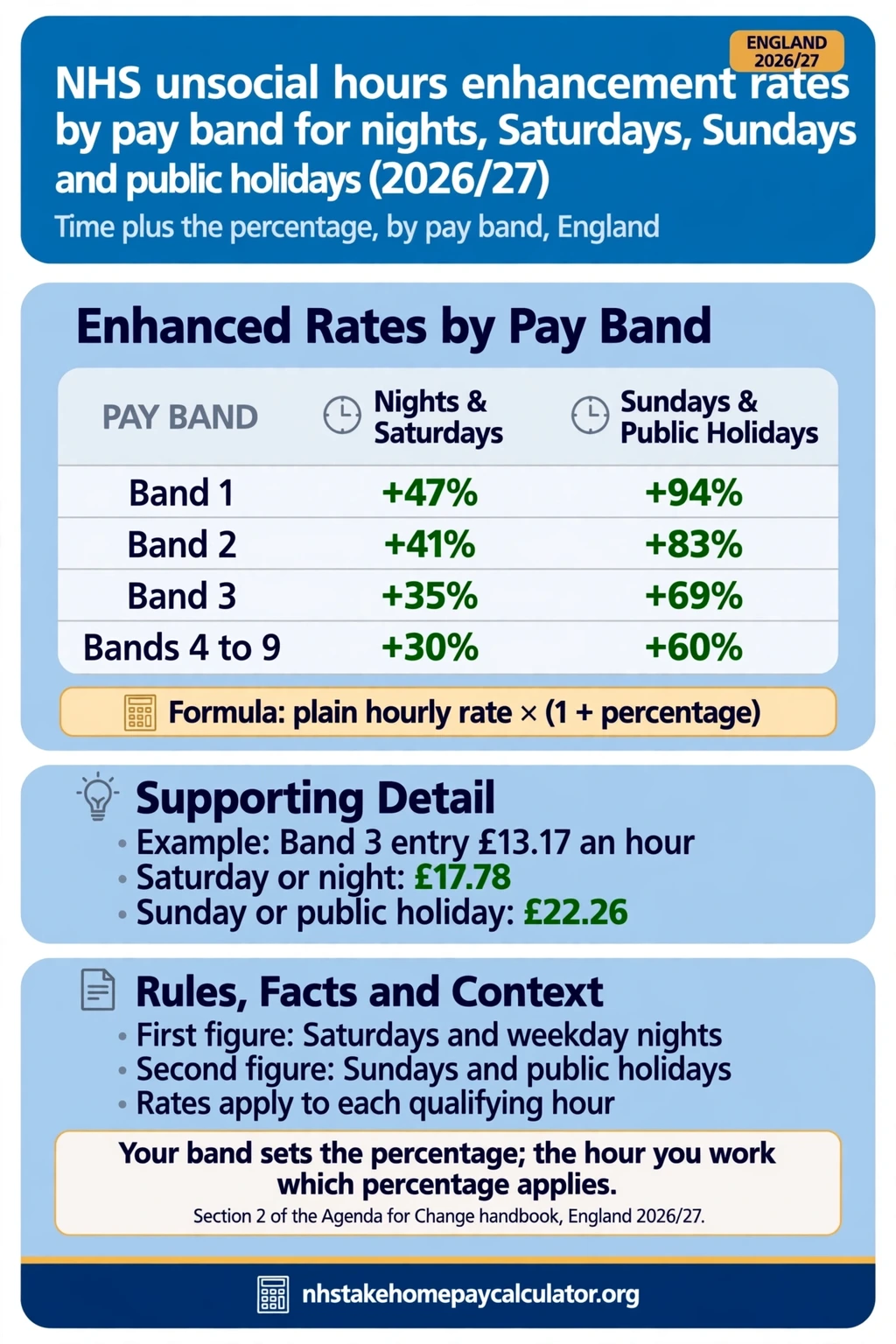
These apply to staff on Agenda for Change terms in England. Your own entitlement is in your contract, and some roles, particularly in senior or on-call posts, are paid on different terms.
What counts as unsocial hours?
Three windows attract the enhancement.
- Saturdays. All day, from midnight to midnight.
- Weekday nights. From 8pm to 6am, Monday to Friday.
- Sundays and public holidays. All day, at the higher percentage.
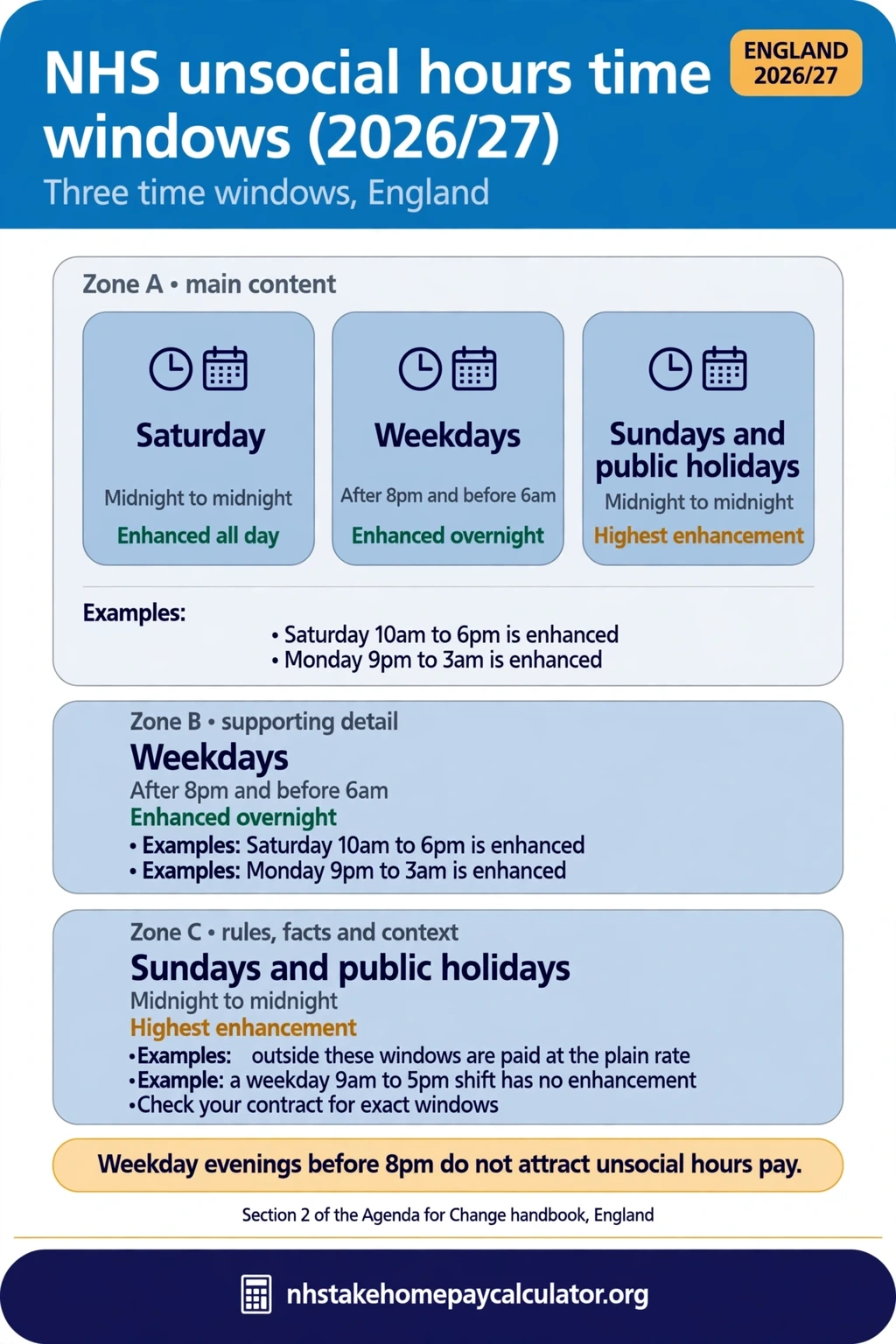
Hours outside those windows, such as Monday to Friday between 6am and 8pm, are paid at the plain rate. Night shifts that cross a boundary are split, so the part before 8pm is plain, the part after is enhanced, and the part after midnight on a Sunday earns the higher percentage.
What the plain hourly rate is
The enhancement is a percentage of your plain hourly rate, which is your annual pay divided by 52.143 weeks and by 37.5 hours. These are the official 2026/27 entry-point hourly rates for the bands that use them.
| Band (entry point) | Plain rate | Saturday or weekday night | Sunday or public holiday |
|---|---|---|---|
| Band 2 | £12.92 | £18.22 | £23.64 |
| Band 3 | £13.17 | £17.78 | £22.26 |
| Band 4 | £14.52 | £18.88 | £23.23 |
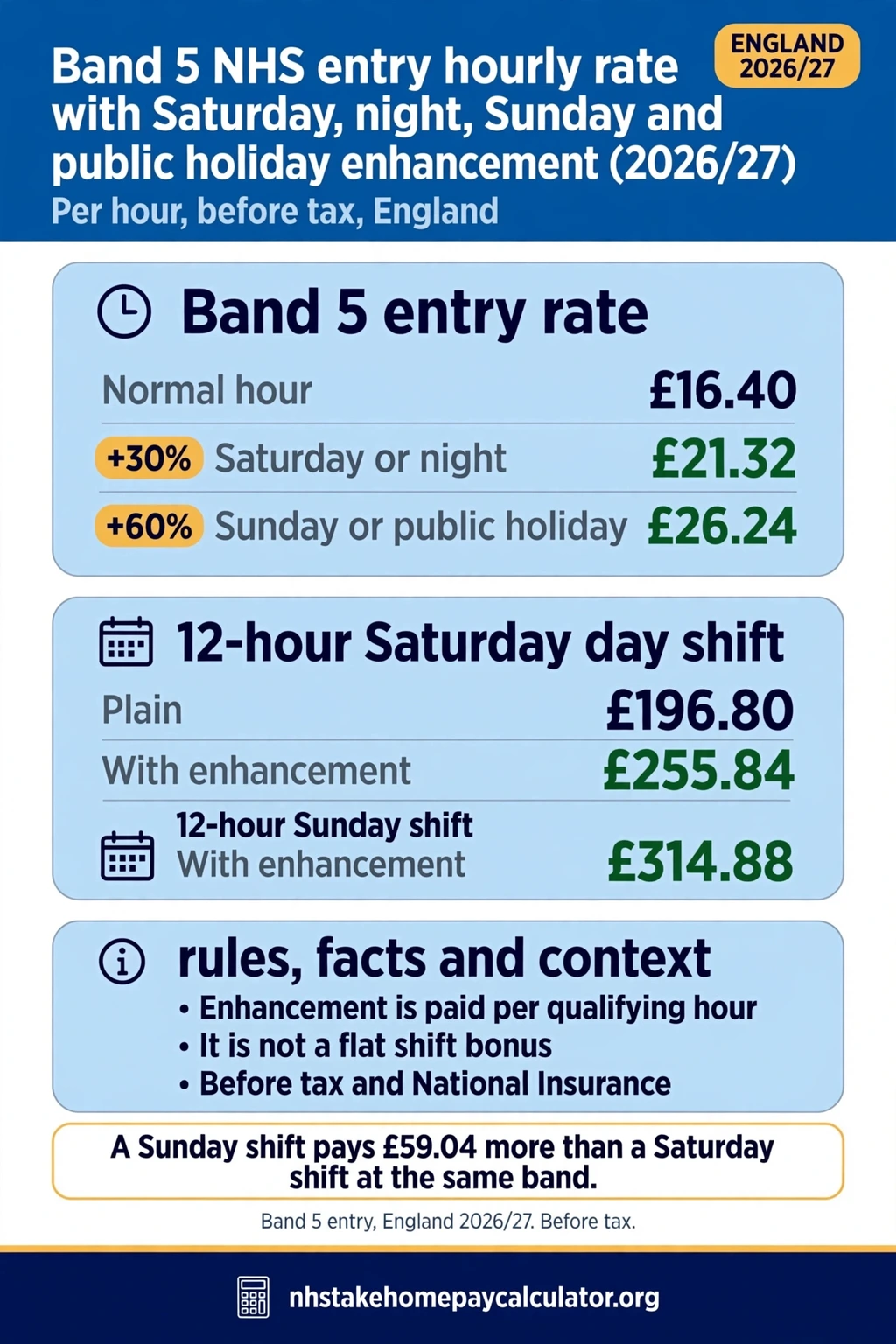
| Band 5 | £16.40 | £21.32 | £26.24 |
| Band 6 | £20.44 | £26.57 | £32.70 |
| Band 7 | £25.26 | £32.84 | £40.42 |
| Band 8a | £29.42 | £38.25 | £47.07 |
At the top of each band the same percentages apply to a higher plain rate. Band 5 top is £19.97 plain, £25.96 on a night and £31.95 on a Sunday.
A Band 5 worked example
A Band 5 nurse at the entry point has a plain rate of £16.40 an hour. Here are three typical monthly shift patterns, assuming each shift is 7.5 paid hours.
| Pattern in a month | Enhancement before tax |
|---|---|
| Light: 1 Sunday and 2 weeknight shifts | £147.60 |
| Typical: 2 Sundays, 2 Saturdays, 4 weeknights | £369.00 |
| Heavy: 4 Sundays, 4 Saturdays, 6 weeknights | £664.20 |
The typical pattern adds £369.00 a month before tax. A basic-rate taxpayer keeps about 72p of each extra pound, so the net is about £265.68. Over a year that comes to roughly £3,188.
How a night shift is split
A 7pm to 7am night shift on a weekday is 12 hours on the clock. The enhanced and plain hours are split like this on a Monday to Thursday night:
- 7pm to 8pm: plain rate (1 hour)
- 8pm to 6am: enhanced at +30% for Band 5 (10 hours)
- 6am to 7am: plain rate (1 hour)
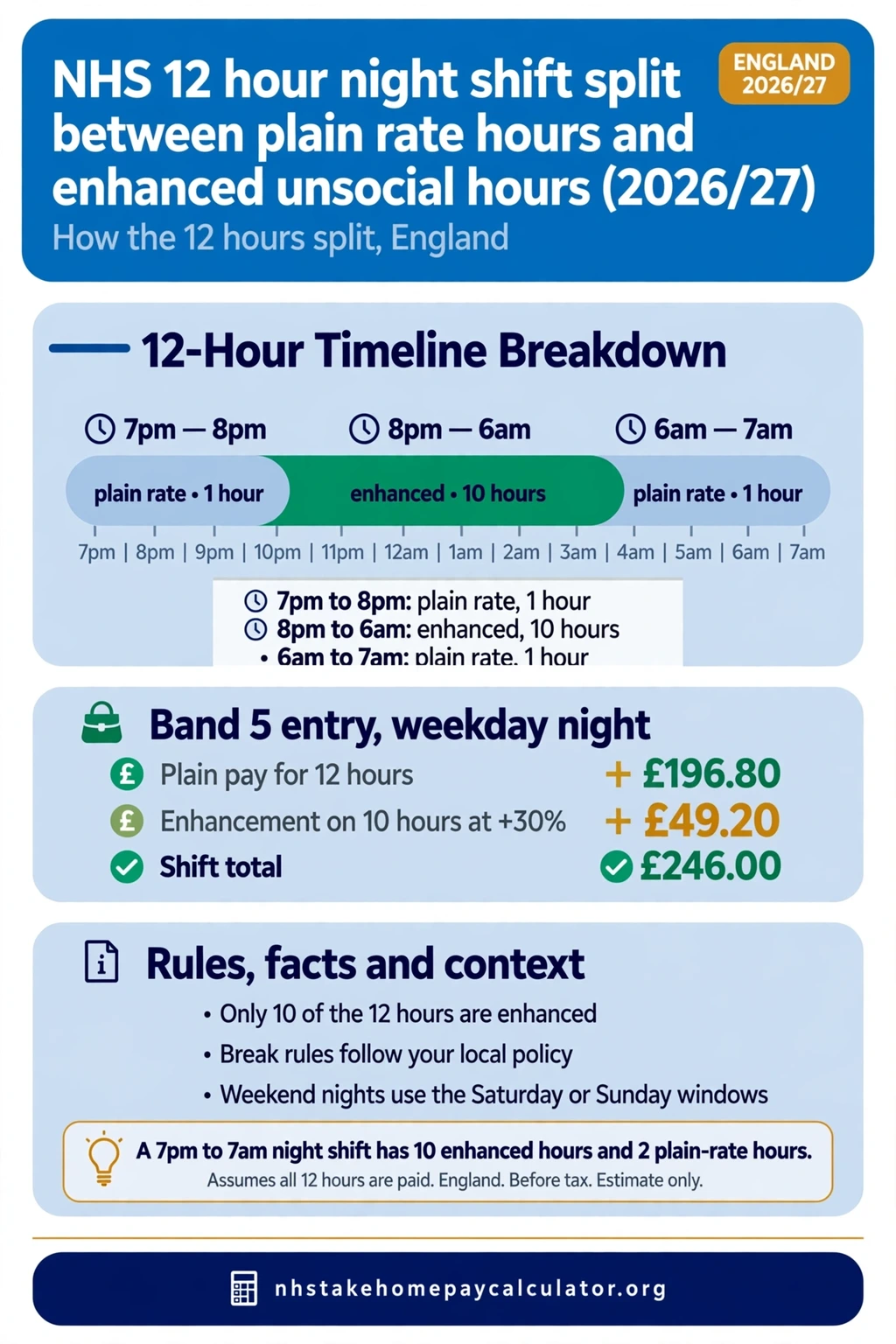
Unpaid breaks are taken out of the paid total, and your trust decides how they are scheduled, so the paid hours differ from the clock hours. What matters is that the first and last hours of a weekday night shift often fall outside the window.
Friday and Saturday nights are different. A Friday 7pm to Saturday 7am shift is mostly enhanced, because Saturday hours after midnight count at the Saturday percentage. A Saturday night into Sunday earns the Sunday percentage after midnight. For Band 5 entry, those Sunday hours pay £26.24 each.
Unsocial hours pay for Bands 2 and 3
Healthcare assistants and support workers gain the most from the percentages because their plain rates are low and their percentages are high.
At Band 2 the plain rate is £12.92. A Sunday hour pays £23.64. A Saturday or weeknight hour pays £18.22. A Band 2 worker doing the typical pattern above (2 Sundays, 2 Saturdays and 4 weeknights) earns £399.23 a month in enhancements before tax.
Band 3 is similar: £13.17 plain, £17.78 on a night and £22.26 on a Sunday. See our healthcare assistant pay guide for the whole picture.
Unsocial hours pay for Bands 6 and 7
At Band 6 entry, the plain rate is £20.44. A Sunday hour pays £32.70. At Band 7 entry the plain rate is £25.26, so a Sunday hour pays £40.42.
The percentage is the same as Band 5, so the extra grows in line with the plain rate. For a manager or specialist on regular office hours, the enhancement may be small or nil, since you only get it for hours that fall in the windows.
The same month across five bands
The same shift pattern is worth different amounts at different bands. This table uses the typical pattern (2 Sundays, 2 Saturdays and 4 weeknights, each 7.5 paid hours) at the entry point of each band.
| Band (entry) | Plain rate | Enhancement a month | After basic-rate tax and NI |
|---|---|---|---|
| Band 2 | £12.92 | £399.23 | £287.44 |
| Band 3 | £13.17 | £343.74 | £247.49 |
| Band 4 | £14.52 | £326.70 | £235.22 |
| Band 5 | £16.40 | £369.00 | £265.68 |
| Band 6 | £20.44 | £459.90 | £331.13 |
| Band 7 | £25.26 | £568.35 | £409.21 |
Band 2 earns £399.23 and Band 7 earns £568.35 on the same pattern. The higher percentages at the bottom of the scale narrow the gap, but they don’t close it.
Checking your own enhancement, step by step
You can check a payslip line in four steps. We’ll use a Band 5 entry nurse who worked one Sunday day shift of 7.5 paid hours.
- Find the plain rate. Band 5 entry is £16.40 an hour.
- Find the percentage. Sundays at Band 5 are +60%.
- Work out the enhanced rate. £16.40 x 1.6 = £26.24 an hour.
- Multiply by hours. £26.24 x 7.5 = £196.80, of which £73.80 is the enhancement and £123.00 is the plain pay you would have had anyway.
If your payslip differs by more than a few pence, ask payroll to explain the hours and the rate they used.
Planning your rota around unsocial hours
Most staff can’t pick every shift, but where you have a choice, the numbers show the trade-off. A Sunday hour at Band 5 is worth £4.92 more than a Saturday or weeknight hour, and £9.84 more than a plain hour. Swapping one weekday day shift for one Sunday day shift adds £73.80 before tax.
That said, rest matters. Pay is a poor reason to stack too many nights or weekends, and your trust may have limits on consecutive shifts. Use the extra pay as a bonus, not a plan.
Do senior bands get unsocial hours pay?
The Agenda for Change percentages in Section 2 list Bands 4 to 9 together at +30% and +60%. In practice, whether a senior post earns enhancements depends on the contract. Many senior roles are salaried for the job rather than for hours, and others include on-call arrangements. Check your contract and your trust’s policy before relying on it.
How much do you keep after tax?
Enhancements are taxed like the rest of your pay. At the basic rate, you lose 20% to income tax and 8% to National Insurance, so you keep 72p of each extra £1. With a student loan at 9%, that falls to 63p. For higher-rate taxpayers it is 58p, or 49p with a student loan.
Taking the Band 5 typical pattern as an example, £369.00 before tax becomes £265.68 at the basic rate and £232.47 with a student loan.
Our model uses these marginal rates because they match how payroll works. Check your payslip for the exact figure, since a tax code change can alter it.
Part-time staff
Unsocial hours percentages are the same for part-time staff. The difference is that part-timers working a normal week often choose the shifts, so the enhanced share can be higher or lower than for a full-timer.
If you work 30 hours a week, your plain pay is pro-rata. Enhancements are on top of that, calculated on the hours you actually work in each window. Use the part-time pay calculator for the plain pay part.
How it appears on your payslip
Most trusts show unsocial hours as separate lines, such as “Enhanced night” or “Enhanced weekend”. There is often a lag, so enhancements for hours worked in March may appear in the April payslip. Your roster and timesheet are your evidence.
If lines are missing or wrong, tell your manager and payroll in writing with the dates and shift times. Our guide to overpayments and underpayments explains the process.
Common mistakes
- Using the wrong percentage. Bands 2 and 3 have higher percentages than Bands 4 to 9.
- Counting weekday evenings before 8pm as unsocial.
- Forgetting that hours after midnight on a Sunday earn the Sunday rate.
- Estimating from a gross figure without tax and NI.
- Assuming a bank shift follows the same rules. Bank rates are set by the trust, see bank shift pay and overtime rules.
- Applying the percentage to the wrong hourly rate. Use the plain rate for your own pay point.
Frequently asked questions
How much extra do you get for night shifts in the NHS?
Weekday nights between 8pm and 6am attract +30% for Bands 4 to 9, +35% for Band 3 and +41% for Band 2 in 2026/27. The percentage is added to your plain hourly rate. At the Band 5 entry point that turns £16.40 into £21.32 an hour for each enhanced night hour.
Is Saturday unsocial hours in the NHS?
Yes. Saturdays count as unsocial hours all day, at +30% for Bands 4 to 9, +35% for Band 3 and +41% for Band 2. Saturday attracts the lower percentage, the same as weekday nights, and the extra pay is added to your plain hourly rate.
How much is Sunday pay in the NHS?
Sunday hours attract +60% for Bands 4 to 9, +69% for Band 3 and +83% for Band 2 in 2026/27. The same percentages apply on public holidays. The percentage is added to your plain hourly rate, so a higher band gets a bigger pound amount even at a lower percentage.
How much is a Band 5 Sunday hour?
At the Band 5 entry point a Sunday hour pays £26.24, compared with a plain rate of £16.40, which is £9.84 more for each hour. A 12-hour Sunday shift therefore pays £314.88 before tax.
Are unsocial hours pay and overtime the same?
No. Unsocial hours pay is a percentage added for working in certain time windows. Overtime is paid at time and a half, or double time on public holidays, for hours beyond your contract. See our overtime guide.
Is unsocial hours pay taxed?
Yes. Unsocial hours pay is taxed as income and National Insurance applies, so a basic-rate taxpayer keeps about 72p of each extra £1 before any pension or student loan deduction. It also counts as gross pay for student loan repayments, so a busy month of nights can raise that month’s repayment.
Do the percentages change each year?
The percentages are set nationally in the Agenda for Change handbook and don’t change with each award. The plain hourly rate they apply to rises with each pay award, so the pound value of an enhanced hour goes up even when the percentage stays the same.
Sources
- NHS Employers: Agenda for Change pay and terms, unsocial hours
- GOV.UK: Income Tax rates and allowances
- GOV.UK: National Insurance rates and categories
- Our own sources and methodology page explains how every figure here is calculated.
Work out your own take-home pay
Enter your band, pay point and hours in the free NHS take home pay calculator for 2026/27.