Home › Agenda for Change: The NHS Pay System Explained
Agenda for Change: The NHS Pay System Explained
Agenda for Change explained: who it covers, how NHS bands and pay points work, and what 2026/27 pay looks like from £25,272 at Band 2 to Band 9.
Quick answer: Agenda for Change is the national NHS pay and conditions framework. It covers most NHS staff except doctors, dentists and some senior managers, sorts jobs into bands, and sets pay points, unsocial hours rates, overtime and progression for each. In England for 2026/27 the bands run from £25,272 at Band 2 to £129,783 at the top of Band 9.
This guide explains what Agenda for Change is, who it covers, how pay is built from its parts and where to find detail on each part.
In this guide
What is Agenda for Change?
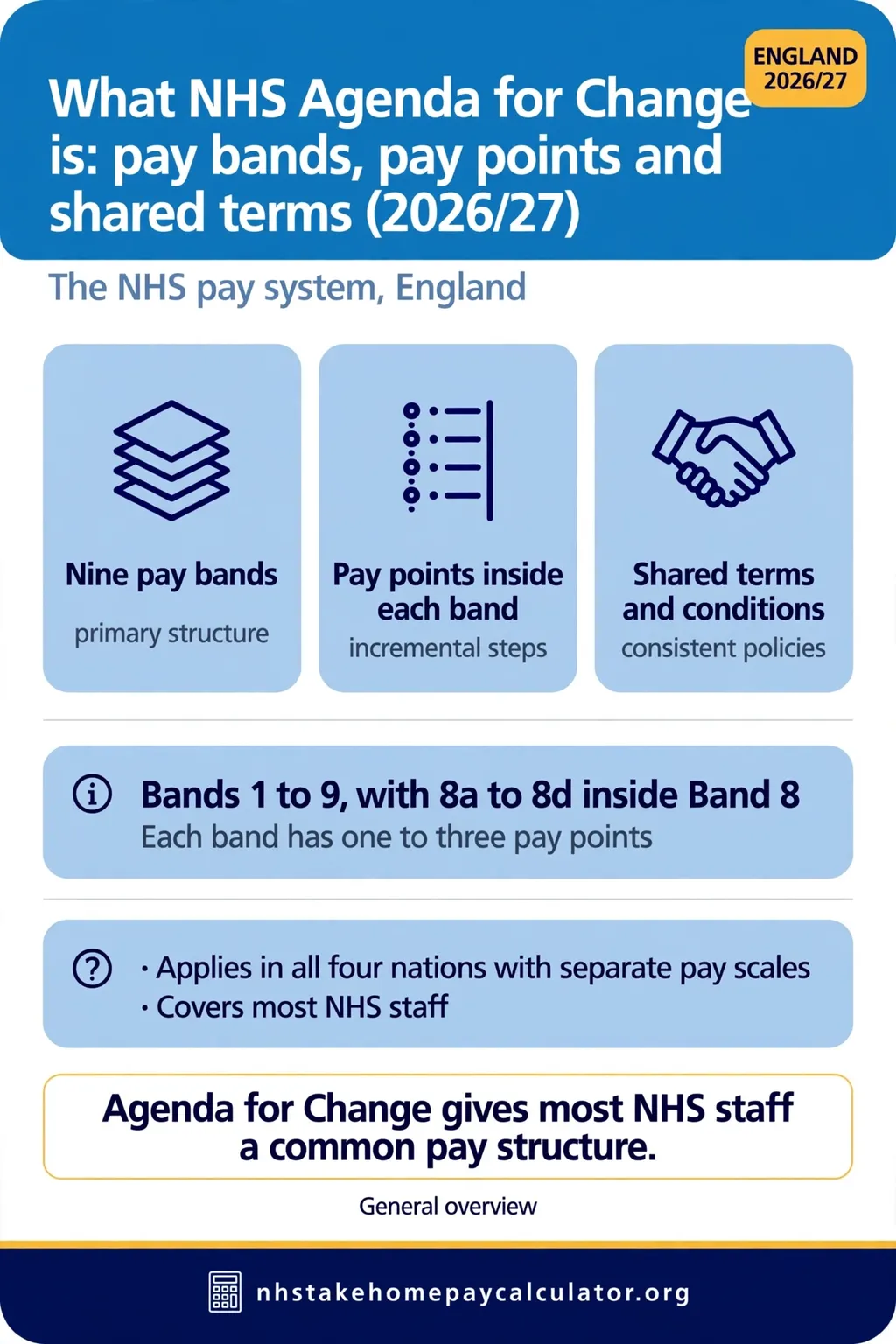
Agenda for Change is the system that decides how most NHS jobs are graded and paid. Each job is evaluated against a national job profile and placed in a pay band. Each band has a set of pay points, and the same band means the same pay range wherever you work in the same nation.
The framework also sets terms such as enhancements for unsocial hours, overtime rates, pay progression and the London weighting supplement. Pay awards are agreed nationally and applied to every pay point.
Who is covered?
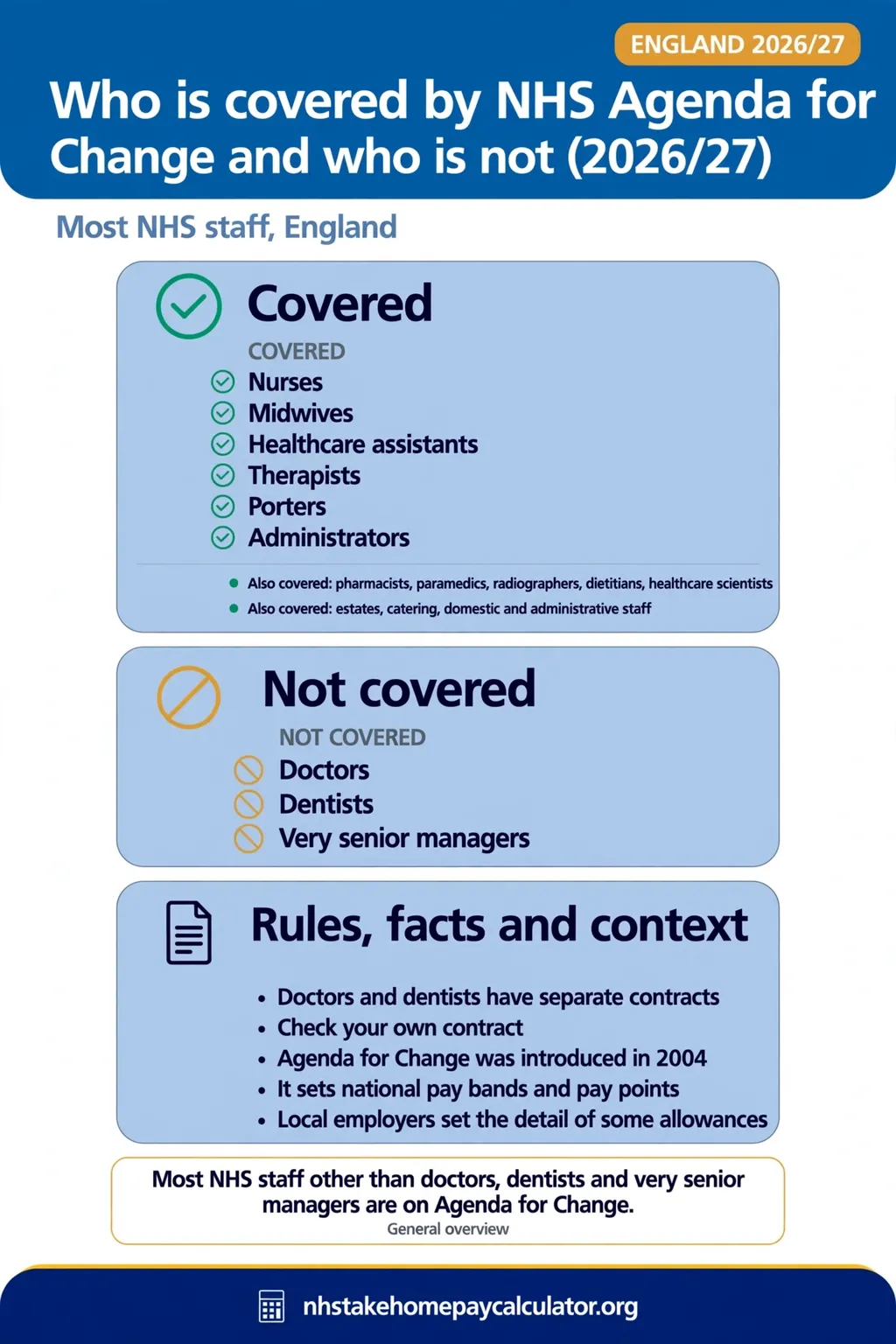
Agenda for Change covers a wide range of NHS roles, including nurses, midwives, allied health professionals, healthcare assistants, paramedics and ambulance staff, healthcare scientists, pharmacy staff, administrative and clerical staff, estates and support staff.
It doesn’t cover doctors and dentists, who have separate contracts, or very senior managers, whose pay is set separately. Some staff in private or non-NHS organisations may be on different terms, even where the work is NHS funded. Your contract tells you which terms apply.
The pay bands
| Band | Annual pay (2026/27, England) | Take-home a month at entry |
|---|---|---|
| Band 2 | £25,272 to £25,272 | £1,700.11 |
| Band 3 | £25,760 to £27,476 | £1,727.27 |
| Band 4 | £28,392 to £31,157 | £1,873.79 |
| Band 5 | £32,073 to £39,043 | £2,040.21 |
| Band 6 | £39,959 to £48,117 | £2,429.77 |
| Band 7 | £49,387 to £56,515 | £2,933.86 |
| Band 8a | £57,528 to £64,750 | £3,352.53 |
| Band 8b | £66,582 to £77,368 | £3,741.70 |
| Band 8c | £79,504 to £91,609 | £4,225.58 |
| Band 8d | £94,356 to £108,814 | £4,850.60 |
| Band 9 | £112,782 to £129,783 | £5,626.03 |
The full list of pay points and hourly rates is on our NHS pay bands page. Take-home figures assume full-time hours, tax code 1257L, NHS Pension and no student loan.
How pay is built
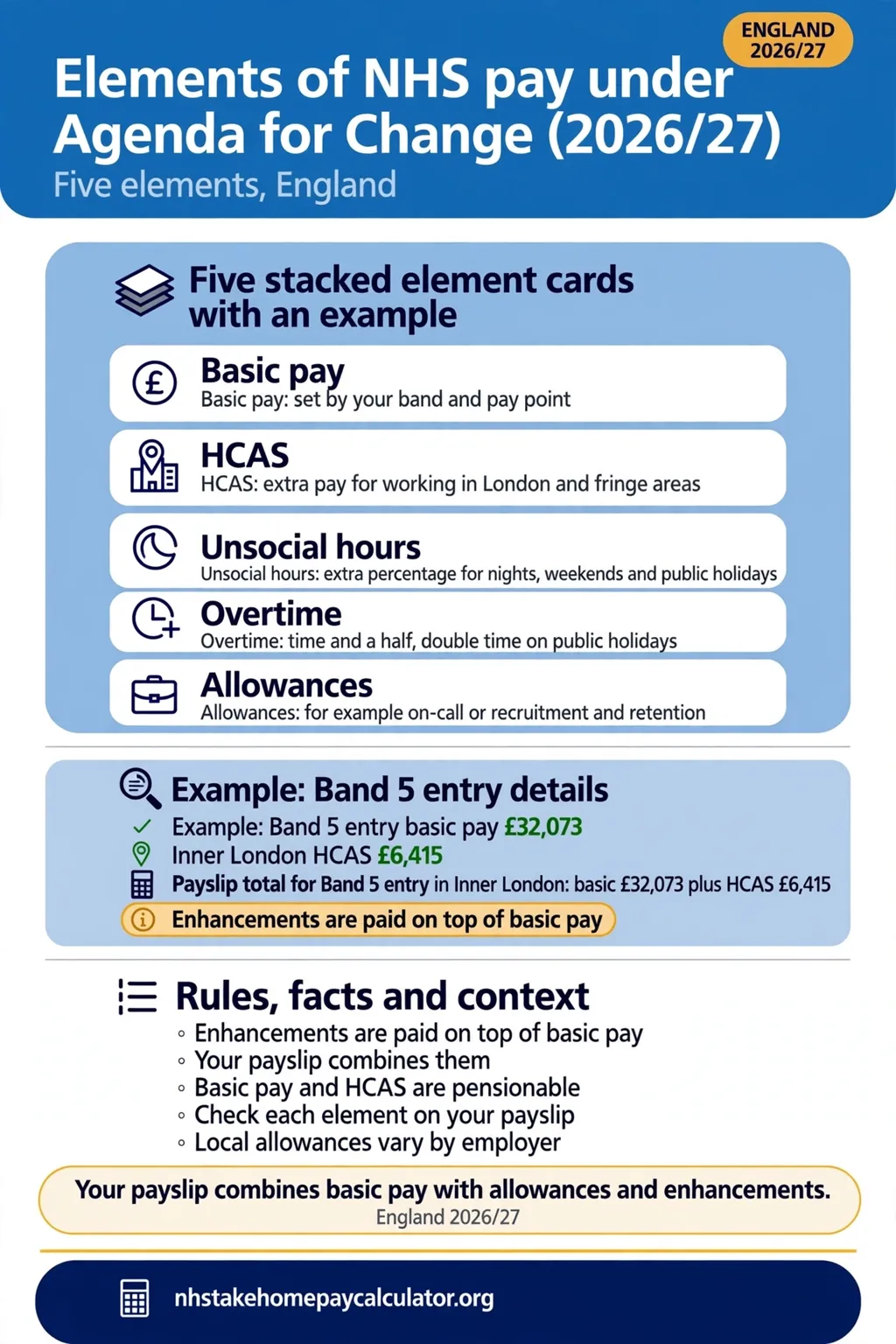
Your pay is made up of a few parts.
- Basic pay. The pay point in your band.
- High Cost Area Supplement. London weighting for staff in the zones. See the HCAS guide.
- Unsocial hours. Enhancements for nights, weekends and public holidays. See the unsocial hours guide.
- Overtime and bank. Extra hours at time and a half or double time, or bank rates. See the overtime guide.
- Deductions. NHS Pension, income tax, National Insurance and student loan. See the payslip guide.
Pay progression
Most bands have more than one pay point, and you move up after a set time if you meet your employer’s conditions. The pay progression guide explains the timings and what a step is worth.
The NHS Pension
Most Agenda for Change staff are in the NHS Pension Scheme, paying a percentage of pensionable pay that depends on a tier from 5.2% to 12.5%, while the employer adds 23.7%. See the pension rates guide.
Pay awards
Pay awards are agreed nationally and applied to the pay points. For 2026/27 the English award is 3.3%, with 3.3% in Wales and 3.75% in Scotland. Our pay rise explained covers the detail.
Topic map: where to find what
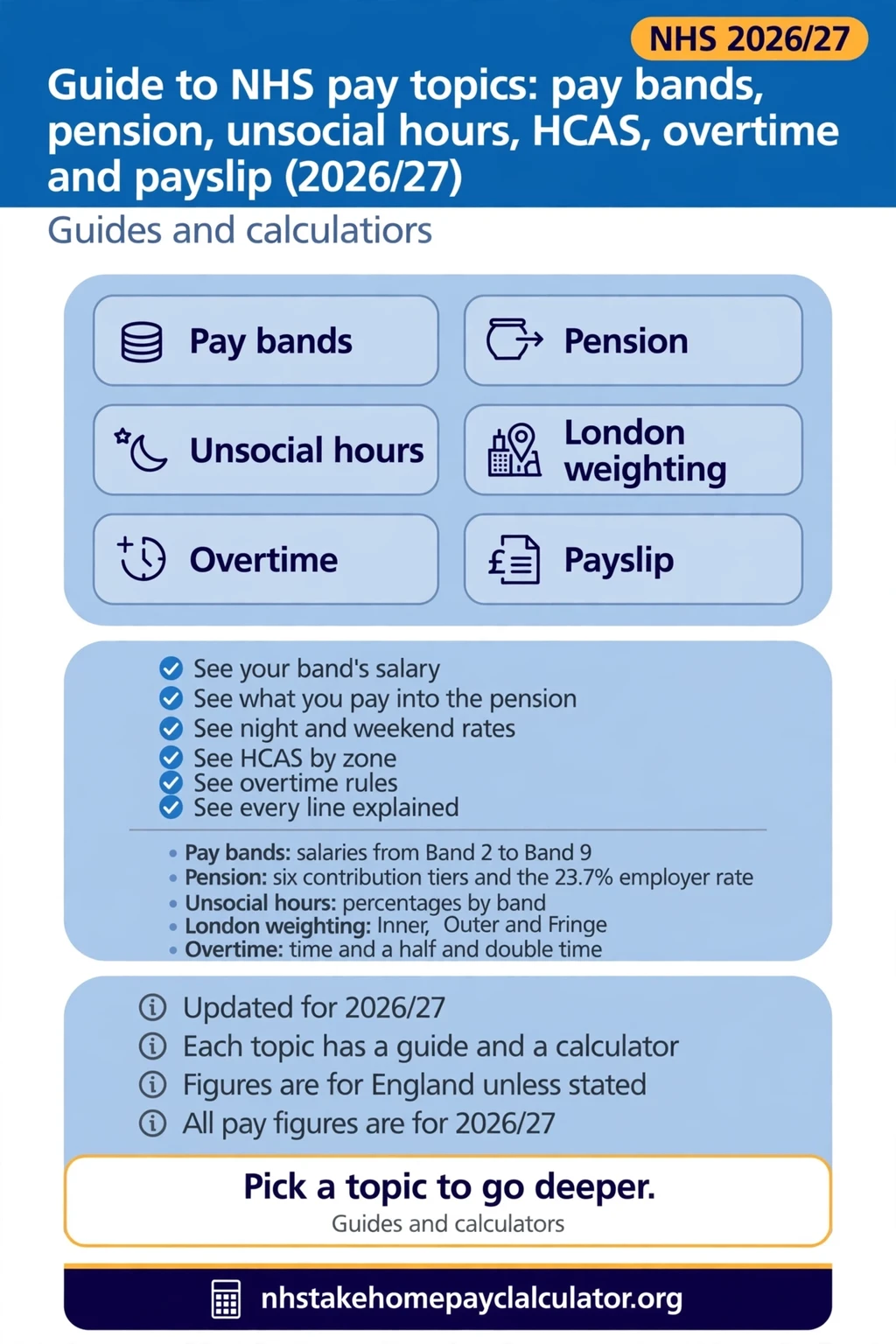
- Find my pay: NHS pay bands
- Work out take-home: Band 5, Band 6, Band 7
- Shift pay: unsocial hours calculator, overtime calculator
- London: HCAS calculator
- Pension: pension calculator
- Student loan: student loan calculator
- Part-time: part-time calculator
- Problems: overpayment and underpayment
Frequently asked questions
What is Agenda for Change?
Agenda for Change is the national NHS pay and conditions framework. It grades jobs into bands using a job evaluation scheme and sets the pay points, unsocial hours rates, overtime, annual leave and progression rules that apply to each band. It covers most NHS staff in the UK except doctors, dentists and some senior managers.
Who is on Agenda for Change?
Most NHS staff apart from doctors, dentists and very senior managers are on Agenda for Change. That includes nurses, midwives, healthcare assistants, allied health professionals, healthcare scientists, pharmacy staff, porters, administrators and many managers. Your contract states whether Agenda for Change terms apply to you.
How many pay bands are there?
Bands 2 to 9 are in use for most roles, with Band 8 divided into 8a, 8b, 8c and 8d. In 2026/27 the England scale runs from £25,272 at Band 2 to £129,783 at the top of Band 9.
Is Agenda for Change the same in every UK nation?
The framework is shared, but each nation publishes its own pay scales and awards. The 2026/27 award is 3.3% in England and Wales and 3.75% in Scotland, and Northern Ireland follows its own process. Always check the pay circular for the nation where you work.
How do I find my band?
Look at your contract and job description, because the band is part of your terms. If your duties don’t match your band, ask your manager about a banding review through the job evaluation process, and speak to your union rep. Our pay bands page lists typical roles for each band.
Sources
- NHS Employers: Agenda for Change
- NHS Business Services Authority: NHS Pension Scheme
- Our own sources and methodology page explains how every figure here is calculated.
Last updated: 25 October 2026
Work out your own take-home pay
Enter your band, pay point and hours in the free NHS take home pay calculator for 2026/27.