Home › NHS pay bands › NHS Pay Rise 2026/27 Explained
NHS Pay Rise 2026/27 Explained
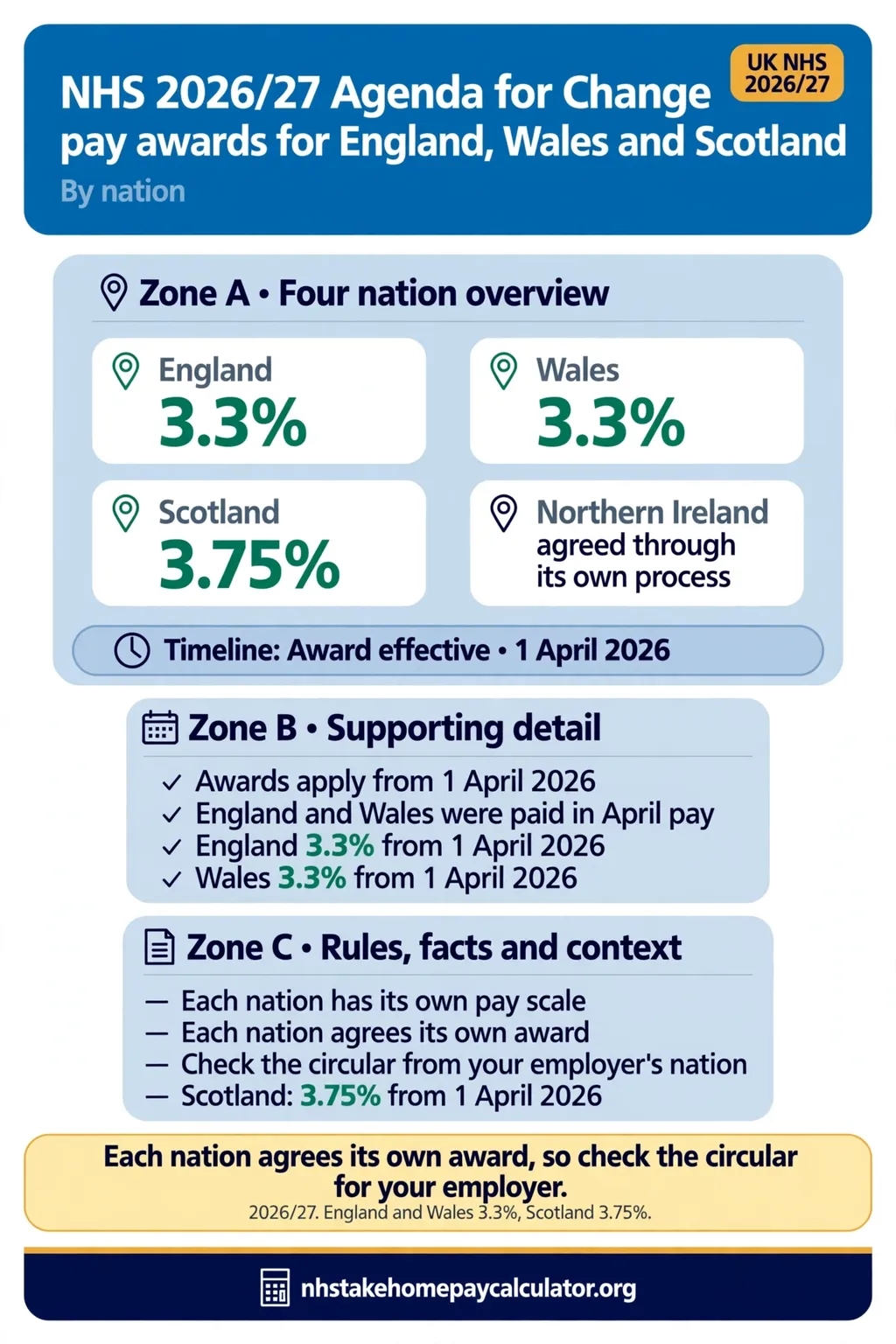
The 2026/27 NHS pay rise explained: 3.3% in England and Wales, 3.75% in Scotland, when it applied and what it adds to your monthly take-home pay.
Quick answer: The 2026/27 NHS pay award is 3.3% in England and Wales and 3.75% in Scotland, and Northern Ireland follows its own process. In England the Band 5 entry point rose from £31,049 to £32,073, a gross rise of £1,024. After pension, tax and National Insurance that is about £669 more take-home a year, or £55.77 a month.
A headline percentage tells you how much your salary changed, but not how much more you’ll take home. Pension, tax and National Insurance all take a share of a rise, and for some people crossing a pension tier takes more.
This guide explains the 2026/27 awards by nation, shows gross and take-home changes at Bands 5, 6 and 7 and explains what to check on your payslip. Enter your own salary in the calculator above.
In this guide
- The 2026/27 pay awards by nation
- What the award means for England pay points
- Band 5 entry: before and after
- Band 6 entry: before and after
- Band 7 entry: before and after
- Why take-home rises by less than the pay award
- When a pay rise changes your pension tier
- What to check on your payslip
- An award versus a pay-step: which is bigger?
- Checking your pay rise step by step
- Backdated pay and arrears
- Pay rise or pay-step?
- Part-time and bank staff
- What the pay rise means in real terms
- Frequently asked questions
- Sources
The 2026/27 pay awards by nation
| Nation | Award | Notes |
|---|---|---|
| England | 3.3% | From 1 April 2026 |
| Wales | 3.3% | 2026/27 |
| Scotland | 3.75% | 2026/27 |
| Northern Ireland | Own process | Follows its own Health and Social Care pay process |
The English award applies to Agenda for Change staff, which covers nurses, midwives, allied health professionals, healthcare assistants and many other roles. Doctors and dentists have separate arrangements, and so do some very senior managers.
We haven’t listed pay points for Scotland, Wales or Northern Ireland because each nation publishes its own pay scales. Our nations guide explains where to find them.
What the award means for England pay points
In England, the main pay points for 2026/27 are these. The entry points for Bands 5, 6 and 7 show the exact change from last year.
| Pay point | 2025/26 | 2026/27 | Rise a year |
|---|---|---|---|
| Band 5 entry | £31,049 | £32,073 | £1,024 |
| Band 6 entry | £38,682 | £39,959 | £1,277 |
| Band 7 entry | £47,810 | £49,387 | £1,577 |
The rise is not exactly 3.3% at every point because pay points are rounded to whole pounds. For example, Band 5 entry rose by 3.3%, Band 6 entry by 3.3% and Band 7 entry by 3.3%.
Band 5 entry: before and after
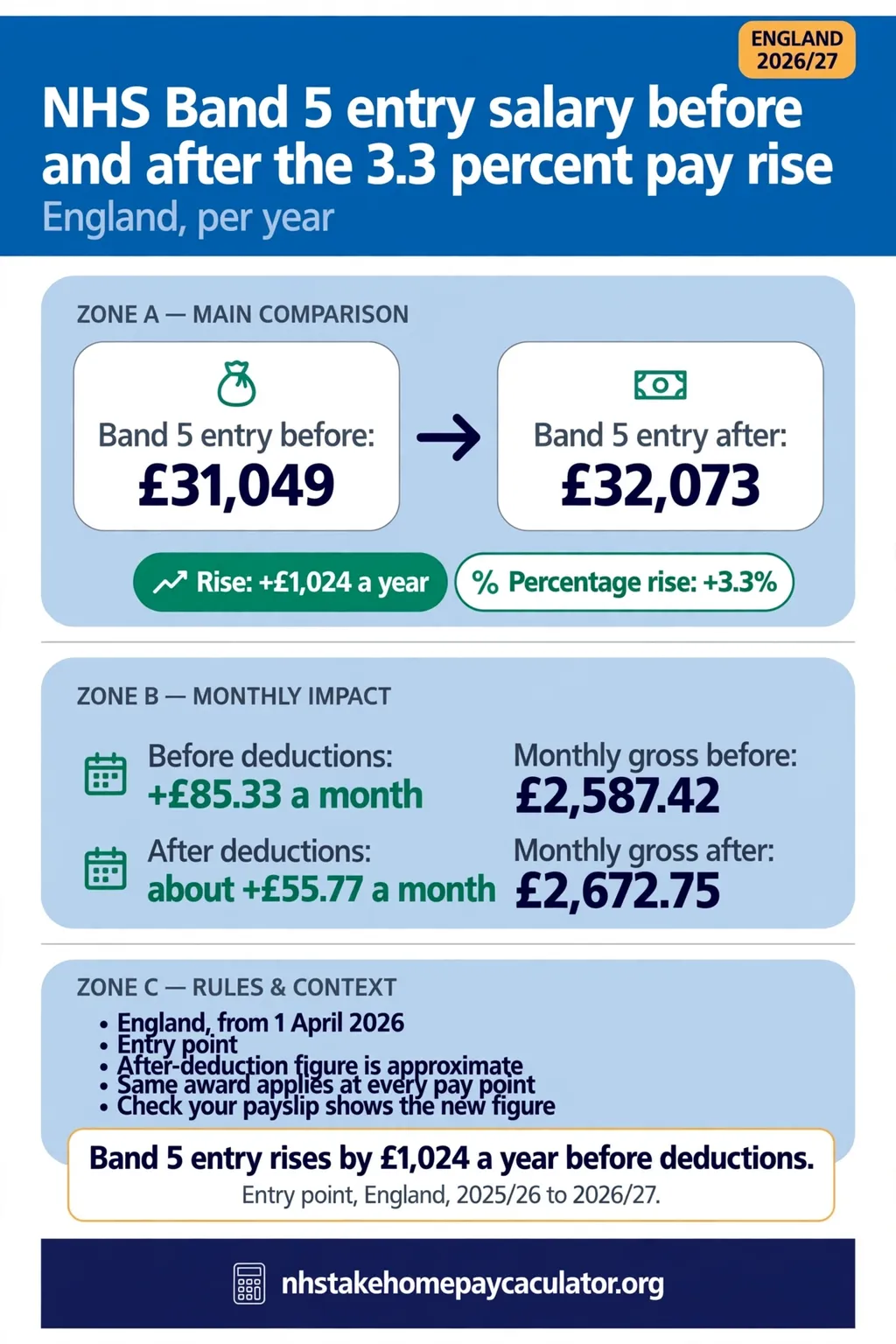
Before: £31,049. After: £32,073. The gross rise is £1,024 a year, or £85.33 a month.
| Band 5 entry, a year | Before | After | Change |
|---|---|---|---|
| Gross pay | £31,049 | £32,073 | £1,024 |
| Pension | £2,577 | £2,662 | £85 |
| Income tax | £3,180 | £3,368 | £188 |
| National Insurance | £1,478 | £1,560 | £82 |
| Take-home | £23,813 | £24,483 | £669 |
These figures apply the 2026/27 tax, National Insurance and pension rules to both salaries, so the table isolates the effect of the pay rise itself. Of the extra £1,024, you keep £669, which is 65p in each £1.
Band 6 entry: before and after
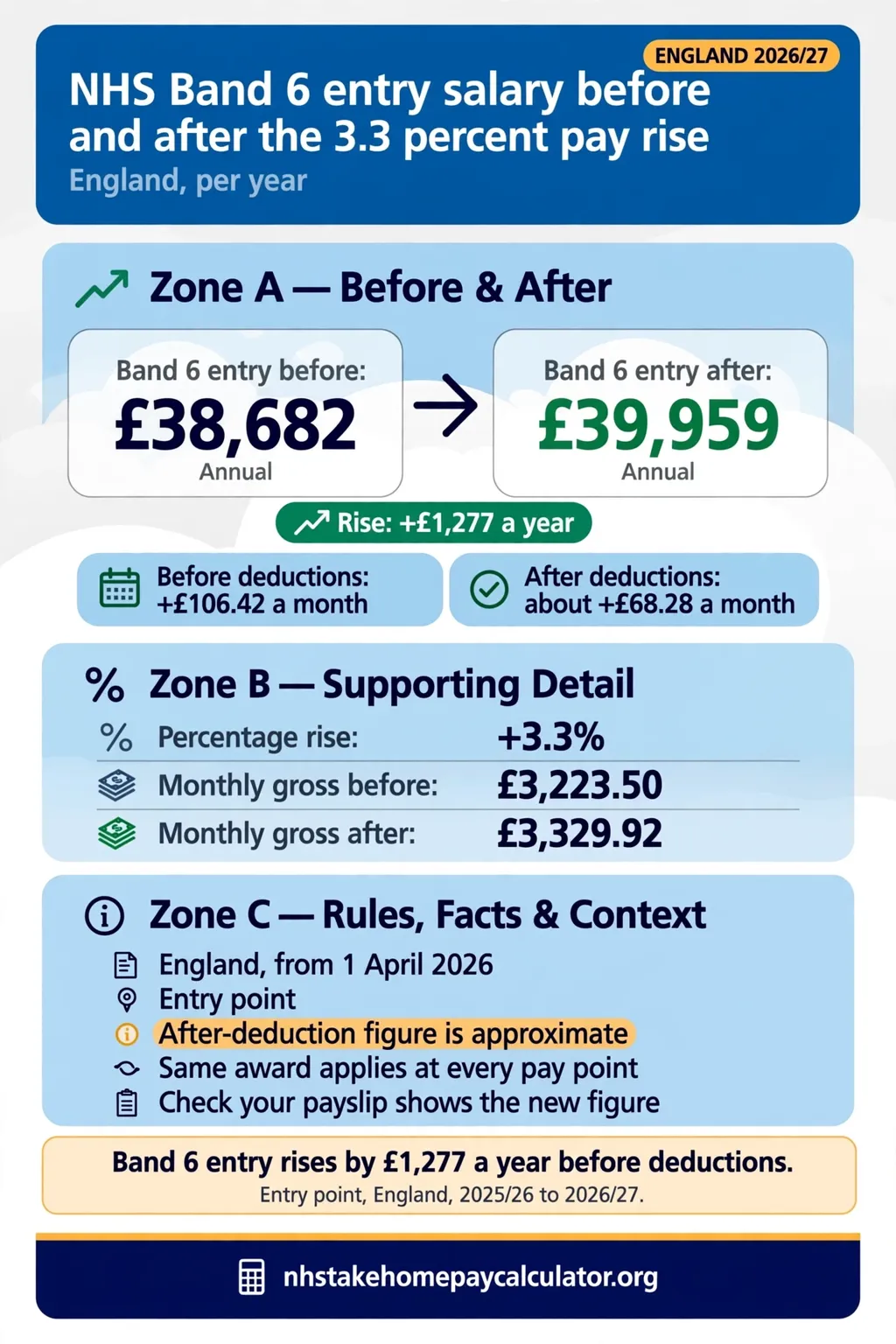
Before: £38,682. After: £39,959. The gross rise is £1,277 a year. Take-home rises by £819 a year, or £68.28 a month. You keep 64p in each £1.
Band 7 entry: before and after

Before: £47,810. After: £49,387. The gross rise is £1,577 a year. Take-home rises by £1,012 a year, or £84.32 a month. You keep 64p in each £1.
At Band 7 entry, taxable pay after pension is £44,547, which is below the £50,270 higher-rate line, so the whole rise is taxed at 20%.
Why take-home rises by less than the pay award
Three deductions take a share of every extra pound.
- Pension. You pay 8.3% at Band 5 entry and 9.8% at Band 6.
- Income tax. 20% on taxable pay above £12,570, and 40% above £50,270.
- National Insurance. 8% on earnings above £12,570 up to £50,270.
At the basic rate those three take 35p of each extra £1 at Band 5. That’s pension of 8.3%, tax of 20% on the pay left after pension, and NI of 8%.
When a pay rise changes your pension tier
Pay rises can push you across a pension tier line. The NHS Pension tier ceilings also rose, by 3.8% in April 2026, which is more than the English pay award. That means fewer people moved up a tier this year than would have if the lines had stayed still.
If you did cross a line, the new rate applies to all of your pensionable pay. At Band 5, the step from the middle point to the top point crosses £35,155, so the rate rises from 8.3% to 9.8%. See our pension rates guide.
What to check on your payslip
First, find the new basic pay. It should be your new annual pay divided by 12. For Band 5 entry that’s £2,672.75.
Second, check whether the rise was paid on time. If your trust needed time to update payroll, you may receive the difference as arrears, often shown as a separate line. Arrears are taxed in the month you get them, which can make that payslip look different.
Third, check your pension rate, using the tiers above.
Fourth, check your tax code. A new code can arrive in April. For one job and no benefits, 1257L is standard. See our payslip guide.
An award versus a pay-step: which is bigger?
For many staff the pay-step is worth more than the annual award. At Band 5 the move from entry to middle adds £2,519 a year, compared with £1,024 from the award at the entry point.
| Band | Entry to middle (gross) | Entry to middle (take-home) | Middle to top (gross) | Middle to top (take-home) |
|---|---|---|---|---|
| Band 5 | £2,519 | £1,646 | £4,451 | £2,441 |
| Band 6 | £2,211 | £1,419 | £5,947 | £3,816 |
| Band 7 | £2,545 | £1,733 | £4,583 | £2,769 |
The take-home columns are a year’s difference. The step from Band 5 middle to top adds £4,451 gross but only £2,441 in take-home, because the pension rate rises at that step.
Checking your pay rise step by step
You can check your own rise in four steps.
- Find last year’s annual pay. It is on a 2025/26 payslip or your contract.
- Find this year’s annual pay. Look at your latest payslip, or use the NHS Employers pay scale for your band and point.
- Subtract. That is your gross rise. For Band 5 entry it’s £1,024.
- Check take-home. Compare your net pay before and after. If the change looks too small, look for a pension tier change, a student loan or a tax code change.
Backdated pay and arrears
If your pay rise wasn’t in place from 1 April, the difference is often paid later as arrears. For a Band 5 nurse at entry, each month of delay is worth about £85.33 gross. Arrears are taxed in the month you get them at your normal rates, so a lump sum can look smaller than you expected. Ask your payroll team how your trust handles late changes.
Pay rise or pay-step?
A pay award moves every pay point up. A pay-step moves you from one point to the next within your band. You can get both in the same year. If you are due a step, the combined rise can be larger, and so can the effect on your pension tier. See pay progression for the timings.
Part-time and bank staff
If you work part-time, the award applies to your pay pro-rata. A Band 5 nurse at entry working 30 hours rose from £24,839 to £25,658, a gross rise of £819. Bank rates are set by your trust, so check its rate card for 2026/27.
What the pay rise means in real terms
Whether a 3.3% award is a real-terms rise depends on inflation, which changes over time. We don’t make that call here, because it depends on which measure and which period you use. Our job is to show what lands in your account. Use the pay rise calculator to work out your own rise.
Frequently asked questions
How much is the NHS pay rise for 2026/27?
The 2026/27 NHS pay award is 3.3% in England and Wales and 3.75% in Scotland. Northern Ireland follows its own process, so the figure depends on its announcement. In England the new pay points apply from 1 April 2026, and the award applies to every Agenda for Change pay point.
How much more will I take home after the 3.3% rise?
It depends on your band. At Band 5 entry, take-home rises by about £55.77 a month, at Band 6 entry by about £68.28 and at Band 7 entry by about £84.32. The rise is smaller than the headline because pension, tax and National Insurance take a share.
When did the 2026/27 pay rise start?
In England the 2026/27 pay points apply from 1 April 2026. When the increase reaches your payslip depends on your trust’s payroll, and any arrears are paid as back pay. Check your payslip for the new basic pay and ask payroll if it hasn’t changed.
Does the pay rise apply to bank staff?
It depends on your trust’s rate card, because bank rates are set locally. Many trusts base them on Agenda for Change hourly rates, so they would change with the award, but check the current rate card with your staff bank team and ask when updates take effect.
Why did my pension rate change after the pay rise?
If the pay rise lifted your pensionable pay over a tier line, your rate rises. The tier ceilings also rose by 3.8% from 1 April 2026, which is more than the 3.3% award, so fewer people are pushed into a higher tier. Check your payslip’s pension percentage against the 2026/27 tiers.
Is the pay rise the same for everyone?
The percentage is the same at every pay point, but the cash amount depends on your band and point. At Band 5 entry, 3.3% adds about £1,024 a year, while higher bands gain more pounds. Anyone paid by the hour receives the same percentage on their rate.
Where do I find official pay scales?
NHS Employers publishes the official Agenda for Change pay scales for England, and each nation publishes its own. Use those pages, or your trust’s HR team, to confirm your band and pay point. Our calculators use the published scales and list them on the sources and methodology page.
Sources
- NHS Employers: pay scales 2026/27
- NHS Business Services Authority: NHS Pension Scheme
- GOV.UK: Income Tax rates and allowances
- Our own sources and methodology page explains how every figure here is calculated.
Work out your own take-home pay
Enter your band, pay point and hours in the free NHS take home pay calculator for 2026/27.