Home › NHS Pay Rise Calculator
NHS Pay Rise Calculator
Free NHS pay rise calculator: see what the 2026/27 award means in pounds for your gross and net pay, by band, hours, pension tier and student loan plan.
Quick answer: Enter your current salary and the calculator applies the 2026/27 award (3.3% for England and Wales, 3.75% for Scotland, or any percentage you choose) and shows the rise in take-home. At Band 5 entry, a rise from £31,049 to £32,073 adds £1,024 gross and about £55.77 a month after pension, tax and National Insurance.
A pay award is quoted as a percentage of salary, but what matters is what lands in your account. This calculator shows the difference.
How to use the NHS pay rise calculator
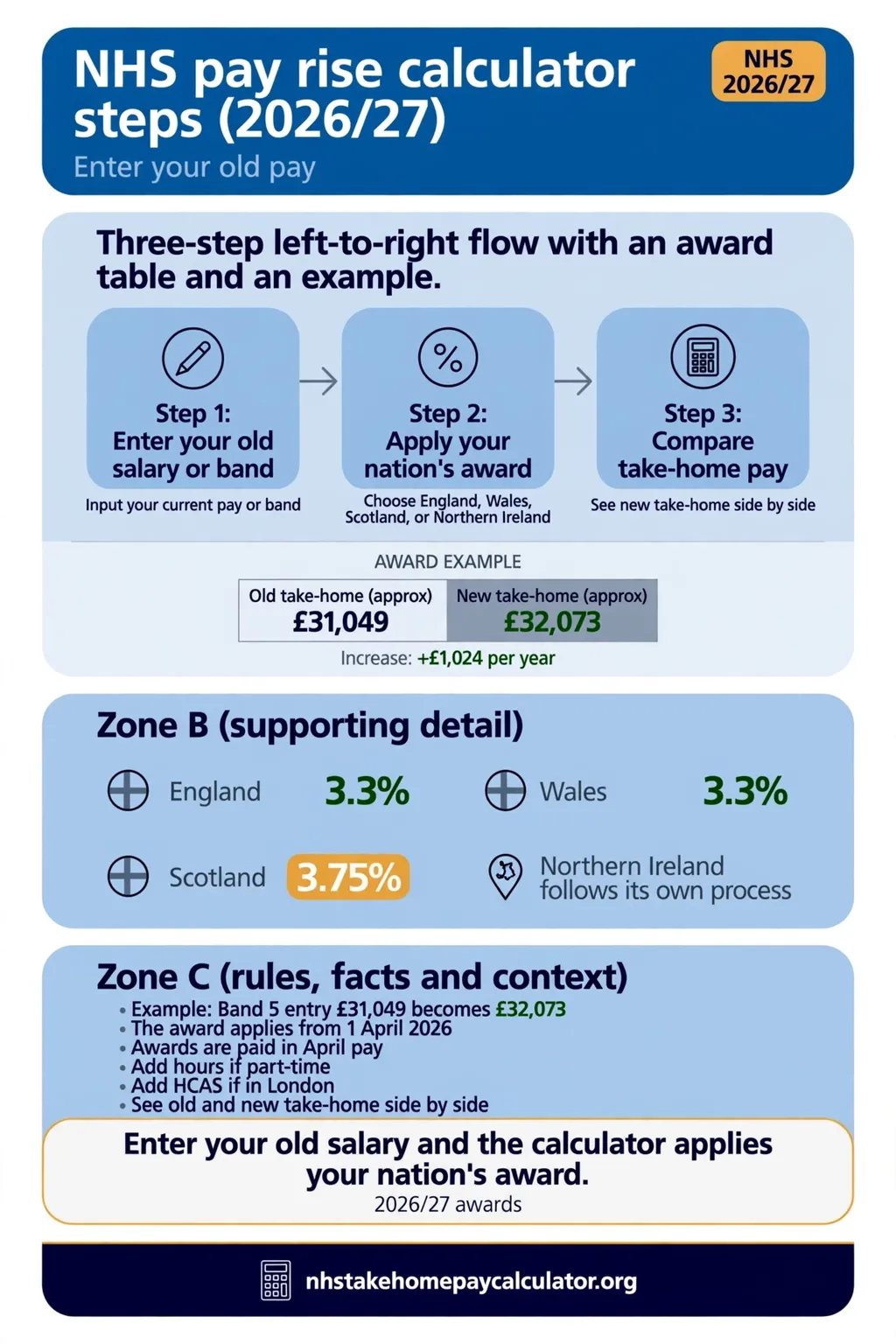
- Pick your nation. England 3.3%, Wales 3.3%, Scotland 3.75%, or enter another percentage.
- Enter your current annual salary before the 1 April 2026 award.
- Enter your weekly hours. Use the full-time salary and your hours.
- Read the result. You’ll see the new salary, the gross rise, any pension tier change and take-home before and after.
Gross rise versus take-home rise
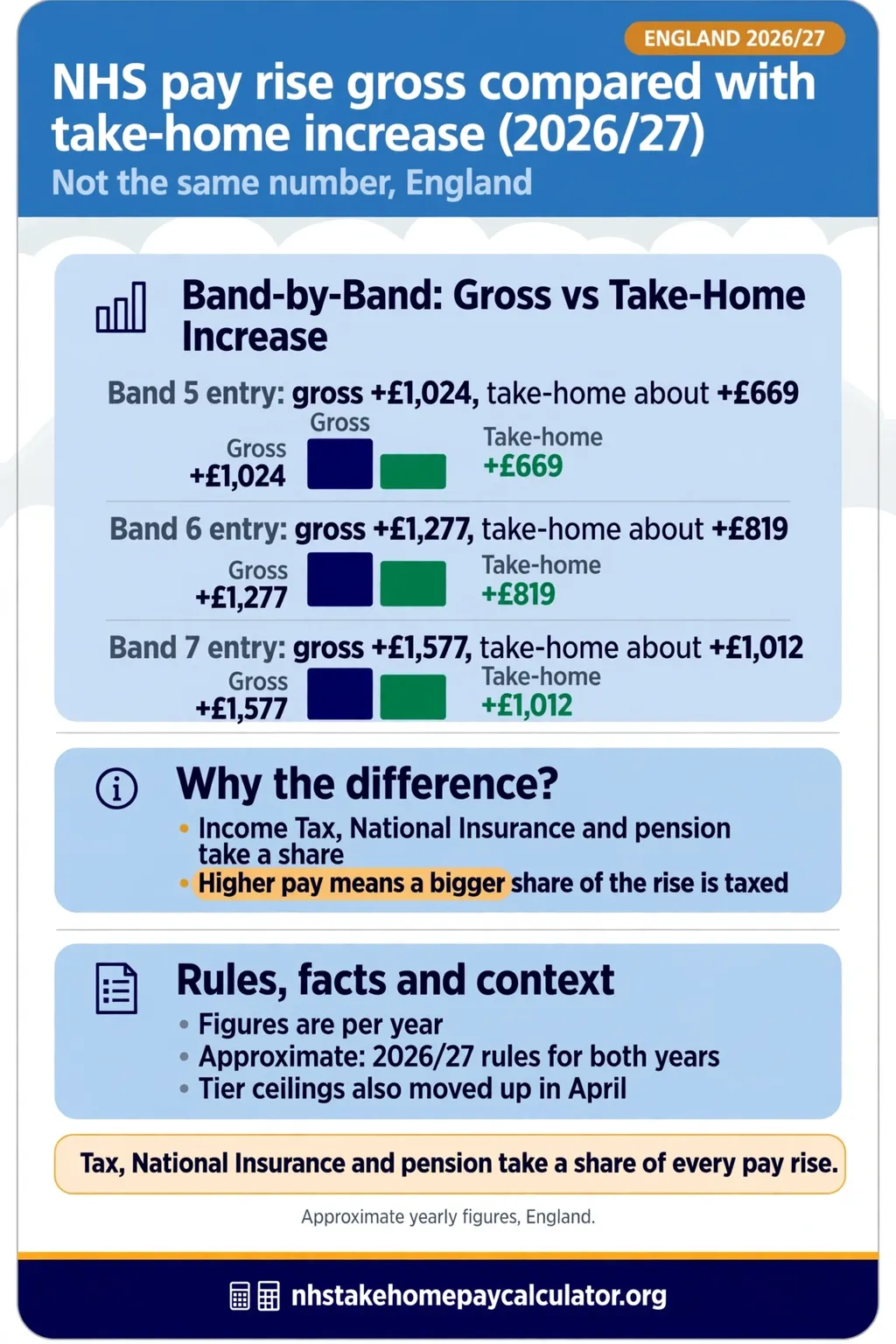
| Pay point | Gross rise a year | Take-home rise a month | Kept of each extra £1 |
|---|---|---|---|
| Band 5 entry | £1,024 | £55.77 | 65p |
| Band 6 entry | £1,277 | £68.28 | 64p |
| Band 7 entry | £1,577 | £84.32 | 64p |
Pension, tax and National Insurance take a share of every rise. At the basic rate the take-home gain is around 60p to 65p in each extra pound, depending on your pension tier.
When a rise moves your pension tier
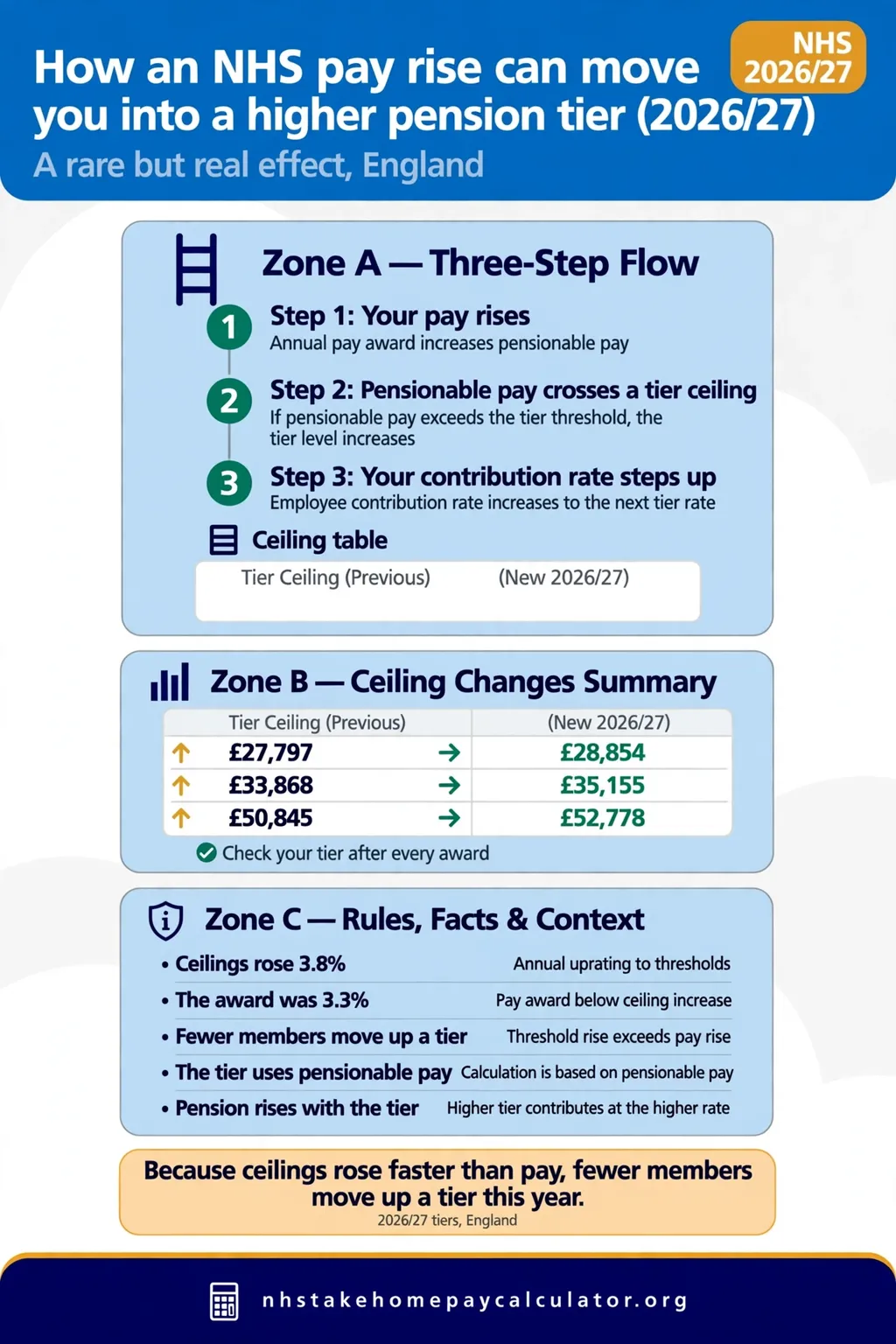
If a pay award pushes your pensionable pay across a tier line, the new rate applies to all of your pay, and your take-home rises by less. The calculator shows the tier before and after. The tier ceilings also rose by 3.8% in April 2026, which is more than the English award, so crossing a line is less common than in other years. See our pension rates guide.
A worked example
A Band 6 nurse at entry sees pay rise from £38,682 to £39,959.
- Gross rise: £1,277 a year
- Pension: 9.8% before and 9.8% after
- Take-home before: £2,361.50 a month
- Take-home after: £2,429.77 a month
- Rise in take-home: £68.28 a month
Who this calculator is for
Use it to check that your April payslip reflects the award, to plan around the real rise in take-home or to compare what the same award would mean at different pay points.
More examples
- Band 2. At £25,272, the 3.3% award is worth about £807 a year gross. Take-home rises by about £44.94 a month, applying 2026/27 rules to both figures.
- Band 5 at 30 hours. The rise on £24,839 to £25,658 is £819 gross.
- Scotland at 3.75%. A salary of £40,000 rises by £1,500 to £41,500 before deductions.
- A custom 2% rise on a salary of £30,000 adds £600 before deductions.
Why your payslip may not match the result
A calculator gives an estimate under clear assumptions, and a payslip reflects your actual month. Differences usually come from four places.
- Timing. Enhancements, overtime and bank pay may be paid a month in arrears.
- Tax code. Our figures assume 1257L. A different code changes tax.
- Cumulative tax. Payroll works out tax across the year, so one month can differ from another.
- Other deductions. Union fees, parking, salary sacrifice and other agreements aren’t included.
If the gap is more than a few pounds and you can’t explain it, ask payroll to walk through the line. Our payslip guide shows what each line means.
Assumptions and limits
The calculator uses the same 2026/27 tax, National Insurance and pension rules for the before and after figures, so it isolates the effect of the rise. The Scotland option uses Scottish income tax bands, but English pension tiers, so treat it as an estimate and check Scottish tiers. It doesn’t include pay-steps, enhancements or student loans. Use the part-time calculator and student loan calculator for those.
Frequently asked questions
How much is the NHS pay rise in 2026/27?
The 2026/27 NHS pay award is 3.3% in England and Wales and 3.75% in Scotland. Northern Ireland follows its own process. In England the new pay points apply from 1 April 2026. Use the calculator to see what the percentage means in pounds for your band and hours.
How much more will I take home?
At the Band 5 entry point the 2026/27 rise adds about £55.77 a month to take-home pay. The exact amount depends on your band, pay point, hours, pension tier and loan plan, so enter your own details in the calculator above.
Why is my take-home rise smaller than the headline?
Because the extra pay is taxed and pensioned. For a basic-rate NHS Pension member, income tax, National Insurance and the pension contribution take a large share of each extra £1, and a student loan takes another 9p, so you keep well under the full amount of the rise.
Does the calculator work for Northern Ireland?
Yes, but only once your award is confirmed. Northern Ireland follows its own pay process, so use the custom percentage option when its award is announced and compare the figures with the official Northern Ireland pay scale. The calculator doesn’t assume a Northern Ireland rate.
Is the rise backdated?
That depends on when your trust applies the award. If the new pay points were applied after 1 April 2026, you should receive the difference as arrears, usually shown as back pay on a later payslip. Ask payroll to confirm the effective date and the arrears amount.
Related tools and guides
- NHS pay rise 2026/27 explained
- Pay progression and pay-step dates
- NHS Pension calculator
- Band 5 take home pay
Sources
- NHS Employers: pay scales 2026/27
- GOV.UK: Income Tax rates and allowances
- Our own sources and methodology page explains every calculation.
Work out your own take-home pay
Enter your band, pay point and hours in the free NHS take home pay calculator for 2026/27.