Home › NHS pay bands › NHS Bank Shift Pay and Overtime Rules
NHS Bank Shift Pay and Overtime Rules
How NHS overtime and bank shift pay work in 2026/27: time and a half, double time on public holidays, tax on extra shifts and what is pensionable.
Quick answer: Under Agenda for Change, NHS overtime is paid at time and a half, with double time on general public holidays. At Band 5 entry that is £24.60 and £32.80 an hour, against a plain rate of £16.40. Bank shifts are different: your trust sets the rate. Either way, extra pay is taxed at your top rate, so a basic-rate taxpayer keeps about 72p of each extra £1.
Extra shifts are the quickest way to lift NHS pay, but the rules aren’t the same for overtime and bank work, and the tax bite surprises many people. This guide explains how each works, with Band 5 worked examples, and shows how much you actually keep.
Use the calculator above to price your own extra hours. Rates in this guide are for England under Agenda for Change for 2026/27.
In this guide
- Overtime rules under Agenda for Change
- A Band 5 overtime example
- How bank shifts work
- Bank shifts compared with overtime
- What you keep after tax
- Do tax codes change for bank work?
- Pension on extra pay
- Working time and rest
- Worked examples at other bands
- Mistakes to avoid
- Frequently asked questions
- Sources
Overtime rules under Agenda for Change
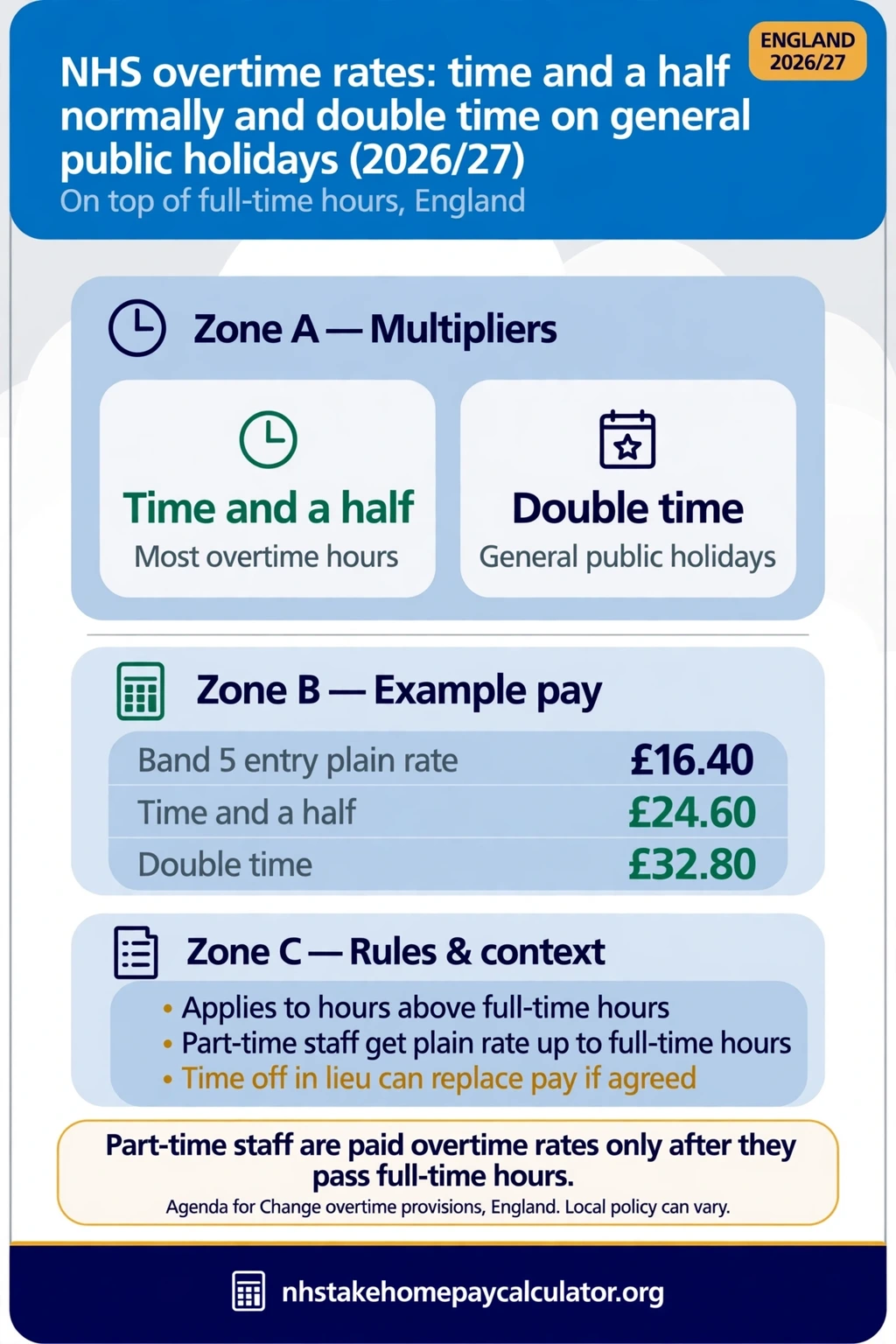
Overtime is work beyond your contracted hours that your manager has asked you to do. The national rates are:
- Time and a half (1.5 times your plain hourly rate) for most overtime.
- Double time (2 times your plain hourly rate) for work on general public holidays.
| Band | Plain rate | Time and a half | Double time |
|---|---|---|---|
| Band 2 entry | £12.92 | £19.38 | £25.84 |
| Band 3 entry | £13.17 | £19.75 | £26.34 |
| Band 4 entry | £14.52 | £21.78 | £29.04 |
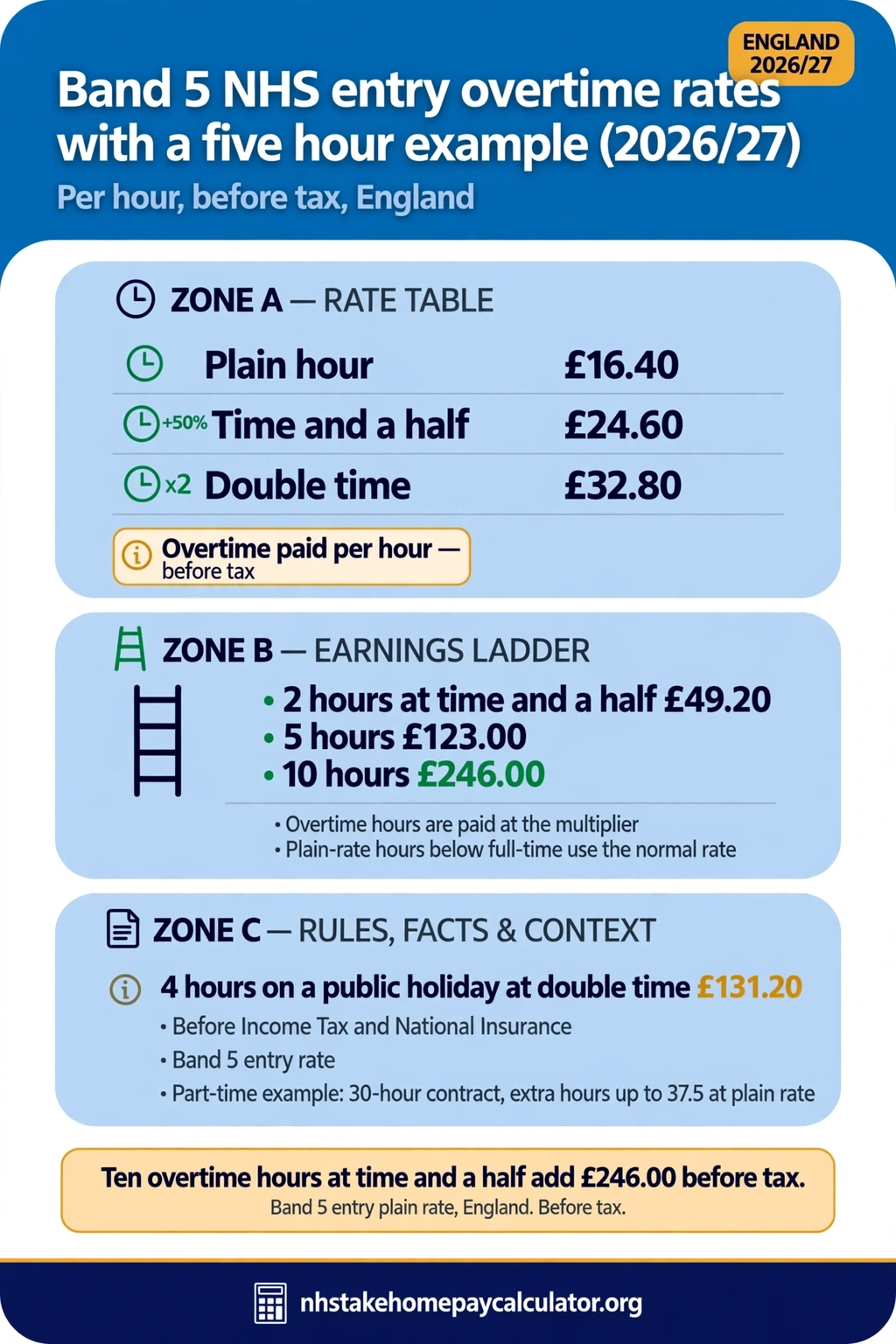
| Band 5 entry | £16.40 | £24.60 | £32.80 |
| Band 6 entry | £20.44 | £30.66 | £40.88 |
| Band 7 entry | £25.26 | £37.89 | £50.52 |
Part-time staff are paid the plain rate for extra hours up to full-time hours, and overtime rates apply once they go beyond. Check your trust’s policy, because arrangements differ.
Whether senior staff are paid for overtime depends on the contract and local policy. Many senior posts are salaried for the job, with time off in lieu instead of pay, so check before you assume.
A Band 5 overtime example
Imagine a Band 5 nurse at entry who works four extra hours on a normal day and one 7.5-hour shift on a general public holiday as overtime.
- Four hours at time and a half: 4 x £24.60 = £98.40
- 7.5 hours at double time: 7.5 x £32.80 = £246.00
- Total before tax: £344.40
After 20% tax and 8% National Insurance, the nurse keeps £247.97. With a Plan 2 student loan the loan takes a further 9%, leaving £216.97.
How bank shifts work
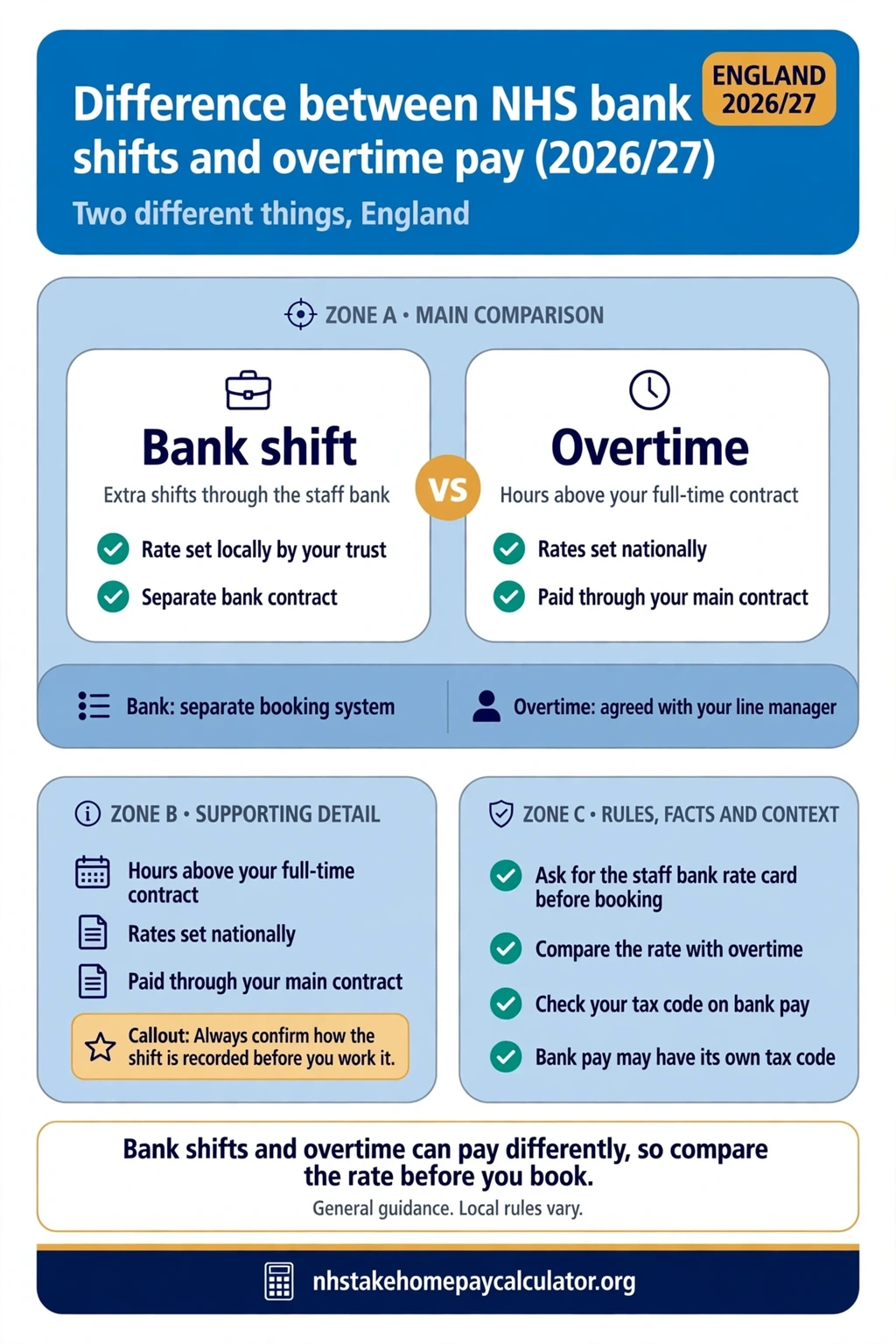
Bank work is extra work through your trust’s staff bank, which is a pool of staff who pick up shifts when needed. You usually register, choose shifts and are paid at a rate on the trust’s rate card.
Bank rates vary. Some trusts pay close to the plain hourly rate of the band, some add enhancements for nights and weekends, and some pay more for hard-to-fill shifts. Because trusts set their own cards, the only reliable source is your trust’s published rates.
Bank shifts compared with overtime
| Overtime | Bank shift | |
|---|---|---|
| Who sets the rate | National Agenda for Change rules | Your trust |
| Typical rate | 1.5x or 2x plain rate | Trust rate card |
| Who arranges it | Your manager | You, through the staff bank |
| Pay slip | Same payroll | Often the same payroll, sometimes separate |
| Pensionable | No | Check your trust’s policy |
At Band 5 entry, a hypothetical bank shift paid at a flat £21.32 an hour would be worth £159.90 for 7.5 hours before tax. That’s less than overtime at time and a half, which pays £184.50. The point is not that overtime is better, but that you should compare the rates before you accept a shift.
What you keep after tax
Extra pay stacks on top of your salary, so it’s taxed at the highest rate you pay. For a basic-rate taxpayer that’s 20% income tax and 8% National Insurance.
| Your situation | Taken from extra pay | You keep of each £1 | You keep of £100 |
|---|---|---|---|
| Basic rate | 28% | 72p | £72.00 |
| Basic rate with a student loan (9%) | 37% | 63p | £63.00 |
| Higher rate (40% tax, 2% NI) | 42% | 58p | £58.00 |
| Higher rate with a student loan | 51% | 49p | £49.00 |
The higher-rate row applies once your taxable pay passes £50,270. Anyone near that line should work out whether a big month of extra shifts pushes part of it into 40% tax.
Do tax codes change for bank work?
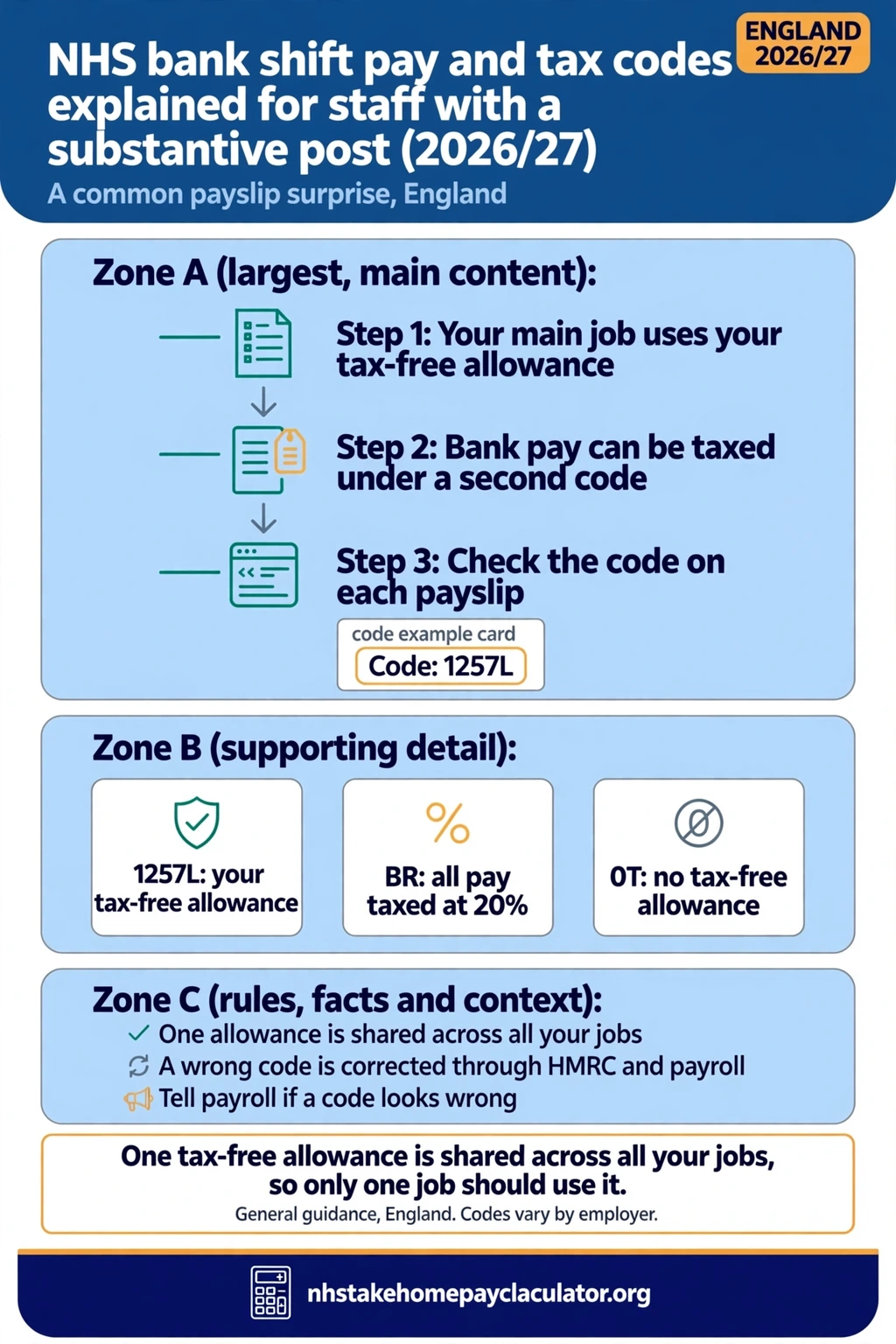
If you do bank work through the same employer, your extra pay usually goes through the same payroll and the same tax code. If bank work is through a different employer, it’s treated as a second job, and you may get a tax code that doesn’t include a personal allowance on that income.
That’s why a second job often shows up as a tax code like BR, which taxes all income at 20%. Check your code on each payslip and in your personal tax account. If it looks wrong, contact HMRC. Our payslip guide explains codes.
Pension on extra pay
Overtime isn’t pensionable, so it doesn’t change your pension tier or your contribution. Bank work depends on how your trust runs it. If you are unsure, ask the staff bank team whether you will be an active member for the shifts.
Working time and rest
Pay is only part of the picture. Extra shifts affect your rest, and working time rules limit how many hours you can work. Your employer will have a policy. Don’t plan your finances around a pattern of extra shifts that you can’t sustain.
Worked examples at other bands
| Ten overtime hours at time and a half | Before tax | After tax and NI | With a 9% student loan |
|---|---|---|---|
| Band 2 entry | £193.80 | £139.54 | £122.09 |
| Band 3 entry | £197.55 | £142.24 | £124.46 |
| Band 5 entry | £246.00 | £177.12 | £154.98 |
| Band 6 entry | £306.60 | £220.75 | £193.16 |
| Band 7 entry | £378.90 | £272.81 | £238.71 |
Ten hours of overtime at Band 2 gives £139.54 after tax and NI. At Band 7 it’s £272.81. The plain rate does most of the work, so the same hours are worth more at higher bands.
Mistakes to avoid
- Assuming bank rates match overtime rates. They don’t unless your trust says so.
- Forgetting that extra pay attracts tax and NI at your top rate.
- Ignoring a possible second-job tax code.
- Counting overtime as pensionable pay.
- Planning your budget around uncertain extra shifts.
Frequently asked questions
Is NHS overtime time and a half?
Yes. Under Agenda for Change, most overtime is paid at time and a half, and hours worked on general public holidays are paid at double time. The rate applies to your plain hourly rate for hours beyond your contract, so check what your trust counts as overtime before you assume a shift qualifies.
How much is overtime for a Band 5 nurse?
At the Band 5 entry point, the plain rate is £16.40 an hour in 2026/27. Time and a half is £24.60 an hour and double time is £32.80. A four-hour overtime shift at time and a half is £98.40 before tax.
How do NHS bank shifts work?
Bank shifts are extra shifts you pick up through your trust’s staff bank. You register with the bank, choose shifts and are paid through payroll at the trust’s bank rate for your band and shift type. Rates and rules vary by trust, so check the current rate card with the bank team.
How are bank shifts taxed?
Bank shifts are taxed like other earnings. A basic-rate taxpayer pays 20% income tax and 8% National Insurance and keeps about 72p in each £1. A second employer may use a different tax code, such as BR, which taxes all of that pay at 20%, so check your code.
Do I get overtime at Band 8 and above?
It depends on your contract and your trust’s policy, and this guide doesn’t assert a standard rule for Band 8 and above. Some senior roles are paid for extra hours in other ways. Check your contract and ask your manager before you rely on overtime pay.
Is overtime pensionable?
No. Overtime is not pensionable under the NHS Pension Scheme, so no pension contribution is taken from it and it doesn’t change your pension tier. It still counts as gross pay for tax, National Insurance and student loan. Additional hours by part-time staff up to full-time hours can differ, so ask payroll.
Sources
- NHS Employers: pay and conditions, overtime
- GOV.UK: Income Tax rates and allowances
- GOV.UK: National Insurance rates and categories
- GOV.UK: tax codes
- Our own sources and methodology page explains how every figure here is calculated.
Work out your own take-home pay
Enter your band, pay point and hours in the free NHS take home pay calculator for 2026/27.