Home › NHS pay bands › NHS Pension Contribution Rates 2026/27
NHS Pension Contribution Rates 2026/27
NHS Pension member contribution rates for 2026/27: six tiers from 5.2% to 12.5%, the 3.8% ceiling rise, the 23.7% employer rate and what a tier change costs.
Quick answer: NHS Pension member contribution rates for 2026/27 run from 5.2% to 12.5%, set by your actual annual pensionable pay. A Band 5 nurse on £32,073 pays 8.3%, which is £221.84 a month before tax relief. Your employer pays a further 23.7%.
Your NHS Pension rate is the one deduction on your payslip that changes when your pay changes in a way you might not expect. The tier ceilings rose by 3.8% in April 2026, so the rate you pay depends on where your pay sits against the new lines.
This guide sets out every tier, shows which tier each pay band and pay point lands in, explains how tax relief works and what happens when a pay rise pushes you over a line. Use the calculator above to find your own tier.
In this guide
- NHS Pension contribution tiers for 2026/27
- Which tier is your pay band in?
- What the employer pays
- How tax relief works
- What happens when you cross a tier line
- Tier ceilings rose by 3.8% in 2026/27
- Part-time staff and pension tiers
- What each tier costs per month
- Two worked examples
- Pension built each year
- Should you opt out?
- Common mistakes with NHS Pension rates
- How to check your pension on your payslip
- Frequently asked questions
- Sources
NHS Pension contribution tiers for 2026/27
The scheme uses six tiers. Your rate is decided by your pensionable pay, and it applies to the whole amount, not only the slice that sits inside the tier.
| Pensionable pay (a year) | Member rate |
|---|---|
| Up to £13,259 | 5.2% |
| £1 to £28,854 | 6.5% |
| £1 to £35,155 | 8.3% |
| £1 to £52,778 | 9.8% |
| £1 to £67,668 | 10.7% |
| Over £0 | 12.5% |
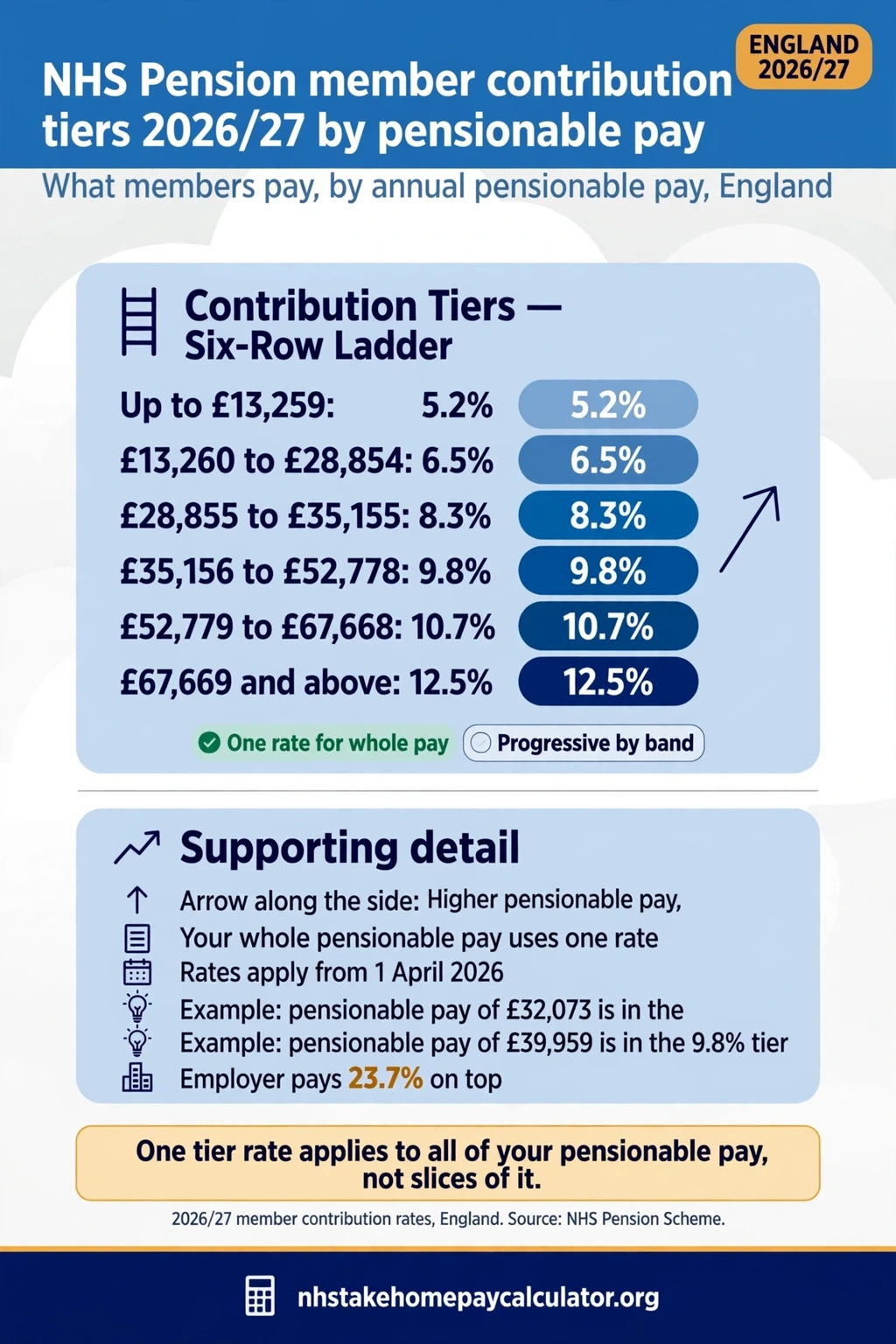
These figures are for members in England, Wales and Northern Ireland of the 2015 scheme. Scotland runs its own scheme with its own rules, so check the Scottish Public Pensions Agency if you work there.
The ceilings rose by 3.8% from 1 April 2026. That is a bit more than the 3.3% pay award in England, so more people stay in their old tier after the rise than would otherwise have been the case.
Which tier is your pay band in?
Pensionable pay is your basic pay plus HCAS, for the hours you work. Overtime isn’t pensionable. Here is where each band’s entry, middle and top point lands, for England 2026/27.
| Band | Entry | Middle | Top |
|---|---|---|---|
| Band 2 | £25,272 (6.5%) | ||
| Band 3 | £25,760 (6.5%) | £27,476 (6.5%) | |
| Band 4 | £28,392 (6.5%) | £31,157 (8.3%) | |
| Band 5 | £32,073 (8.3%) | £34,592 (8.3%) | £39,043 (9.8%) |
| Band 6 | £39,959 (9.8%) | £42,170 (9.8%) | £48,117 (9.8%) |
| Band 7 | £49,387 (9.8%) | £51,932 (9.8%) | £56,515 (10.7%) |
| Band 8a | £57,528 (10.7%) | £60,417 (10.7%) | £64,750 (10.7%) |
| Band 8b | £66,582 (10.7%) | £70,896 (12.5%) | £77,368 (12.5%) |
| Band 8c | £79,504 (12.5%) | £84,346 (12.5%) | £91,609 (12.5%) |
| Band 8d | £94,356 (12.5%) | £100,140 (12.5%) | £108,814 (12.5%) |
| Band 9 | £112,782 (12.5%) | £119,583 (12.5%) | £129,783 (12.5%) |
Where a band shows a blank cell, it has no separate middle point. Bands 2 to 4 have only an entry and a top point, and Band 2 has just one.
A few things stand out. Band 5 spans two tiers: you pay 8.3% at entry and middle, then 9.8% at the top. Band 6 sits in a single tier at 9.8%. Band 7 starts at 9.8% and moves to 10.7% at the top point. Every point from Band 8b middle upward pays 12.5%.
What the employer pays
On top of your contribution, your employer pays 23.7% of your pensionable pay into the scheme. That rate is the same for everyone, whatever tier you are in. It doesn’t come out of your pay and doesn’t appear as a deduction.
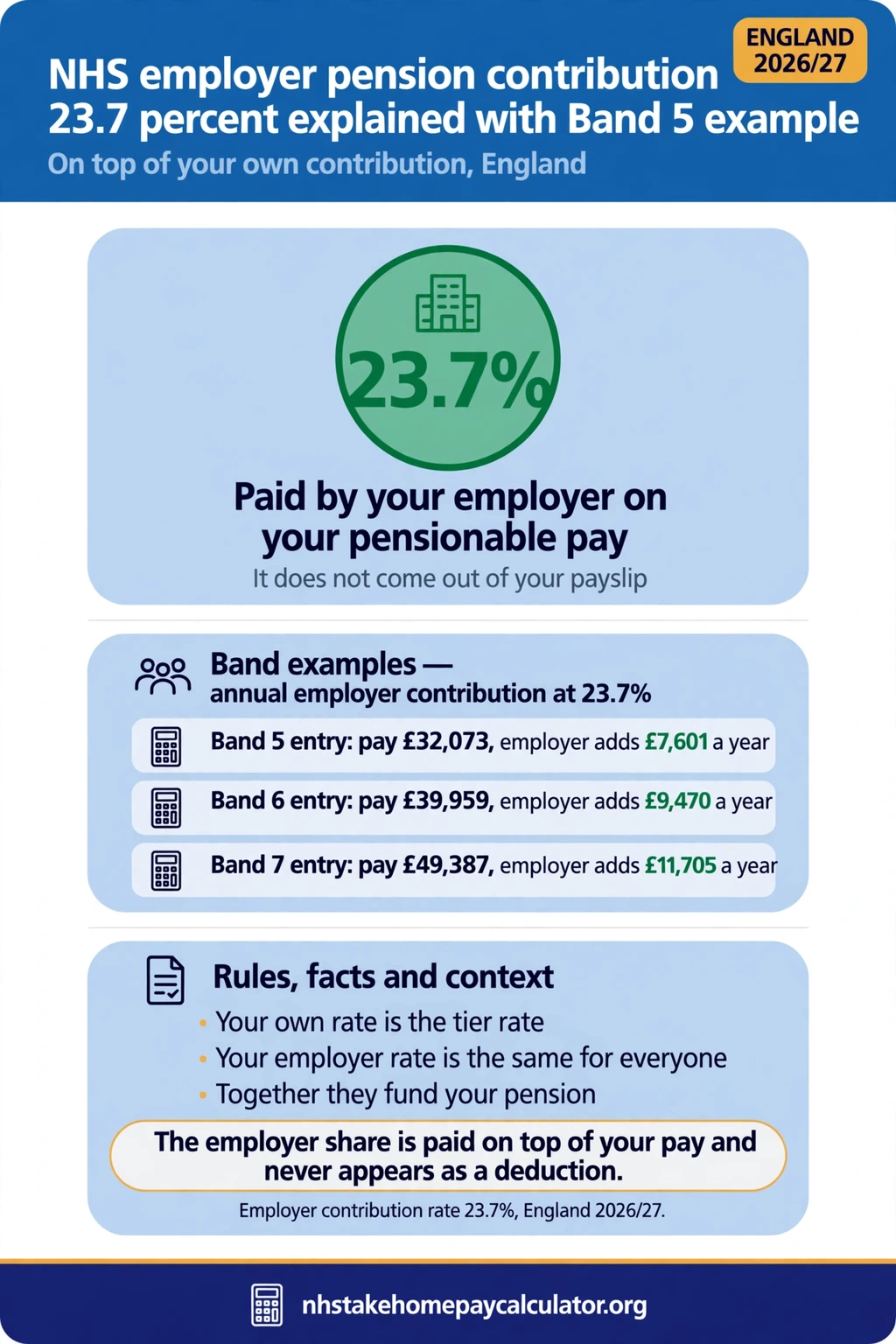
For a Band 5 nurse at entry, employer contributions are £7,601 a year, compared with £2,662 from the member. The employer pays about 2.9 times as much as you do.
How tax relief works
Your NHS Pension contribution is taken from your pay before income tax is calculated. This is called a net pay arrangement. You don’t need to claim anything, and it works automatically through payroll.
For a basic-rate taxpayer, each £1 you pay into the pension costs you 80p in take-home. At Band 5 entry, you pay £2,662 a year, but your take-home is only reduced by about £2,130. That is the effect of the 20% tax relief.
For higher-rate taxpayers, relief is at 40%. At Band 8a entry, the pension costs £6,155, but after tax relief on the part above £50,270 the real cost is lower than a flat 20% would suggest. Use the calculator above for the exact figure.
National Insurance is different. NI is charged on gross pay, so your pension contribution doesn’t reduce it.
What happens when you cross a tier line
Rises that push your pay over a line cost more than they seem to. The new rate applies to all of your pensionable pay, not just the extra.
Take the Band 5 middle and top points. Gross pay rises by £4,451. Because the top point is over £35,155, the rate jumps from 8.3% to 9.8%. Your monthly pension contribution rises by £79.59. Take-home rises by only £203.39 a month.
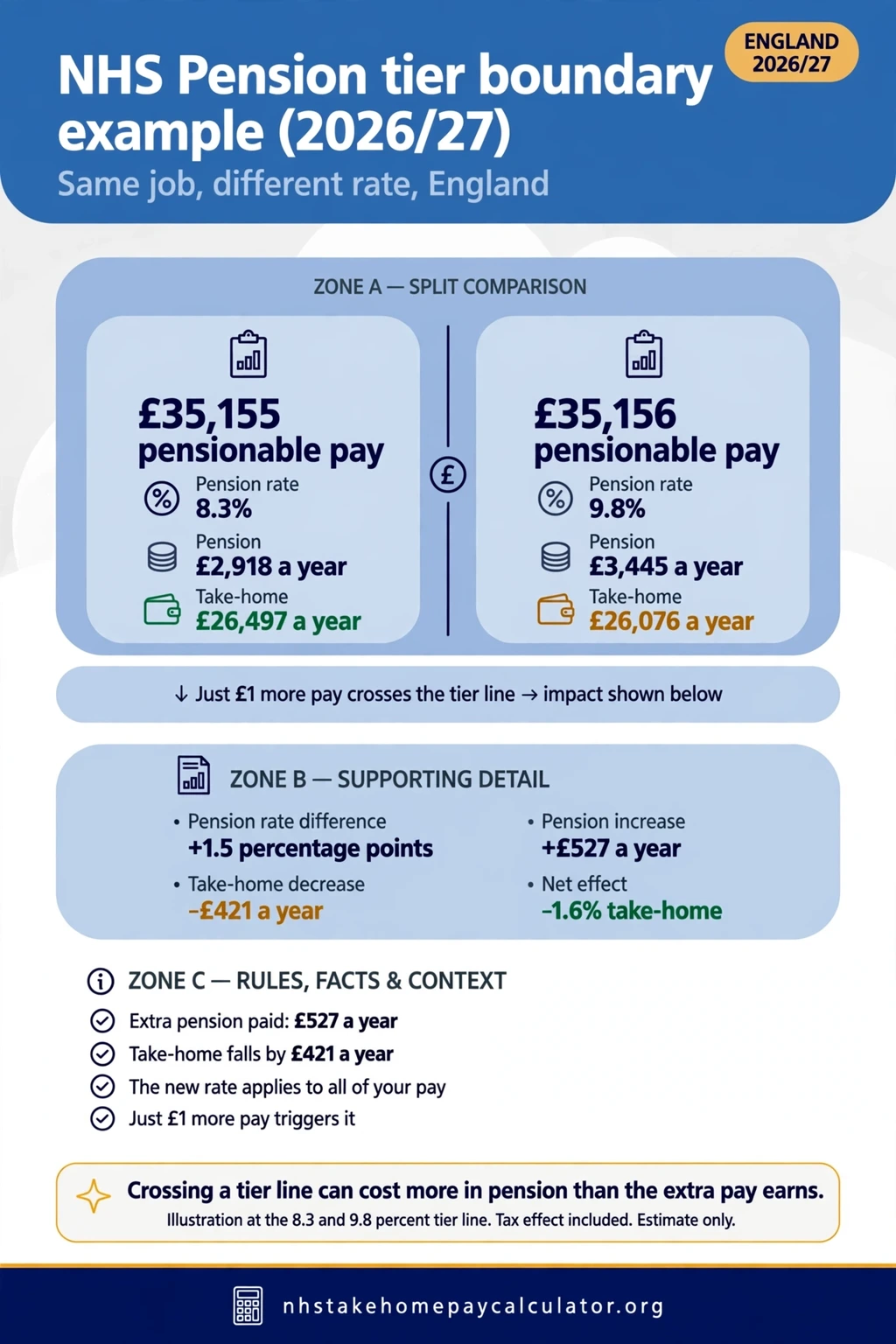
It isn’t a loss, though. The extra goes into your pension, and your employer’s 23.7% also rises with your pay. But if you are budgeting a mortgage or rent on take-home alone, the real gain at the top point is smaller than the pay rise suggests.
Tier ceilings rose by 3.8% in 2026/27
The ceilings move each April, normally in line with the indexation set by the scheme. This year the lines rose by 3.8%.
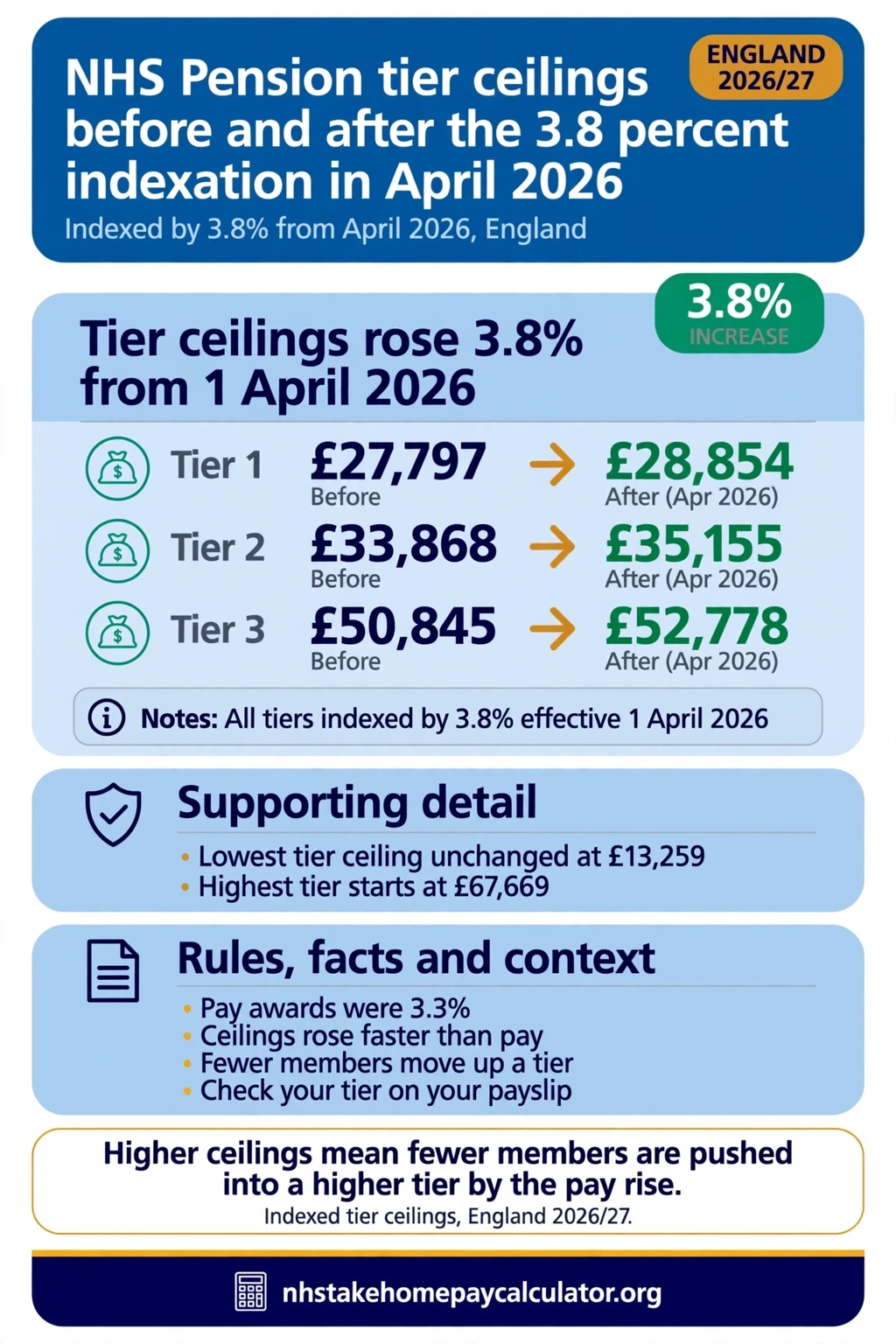
The effect depends on where your pay lands. England’s 3.3% pay award is smaller than the 3.8% rise in the ceilings, so a person whose pay rose by 3.3% is a little less likely to be pushed across a line than before. Someone who got a regrade or a pay-step on top of the award could still cross one.
To see the difference in practice, take a salary of £34,000 in 2025/26 that rose by 3.3% to £35,122. The pay is still under the £35,155 line, so the rate stays at 8.3%.
Part-time staff and pension tiers
NHS Business Services Authority bases the contribution rate on your actual annual pensionable pay, not on a full-time equivalent. That means part-time staff can pay a lower tier than a full-timer on the same band and point.
Take Band 6 entry. Full-time pay is £39,959, which is in the 9.8% tier. On 30 hours, pay is £31,967, which is in the 8.3% tier. The pension contribution falls from £326.33 to £221.11 a month.
Here is Band 5 entry at four different working weeks.
| Hours a week | Annual pay | Pension rate | Pension a month | Take-home a month |
|---|---|---|---|---|
| 37.5 hours | £32,073 | 8.3% | £221.84 | £2,040.21 |
| 30 hours | £25,658 | 6.5% | £138.98 | £1,721.62 |
| 22.5 hours | £19,244 | 6.5% | £104.24 | £1,364.54 |
| 15 hours | £12,829 | 5.2% | £55.59 | £1,011.78 |
The part-time pay calculator lets you try your own hours.
What each tier costs per month
The table shows what a full-time worker pays at the entry point of each band, before tax relief.
| Band (entry) | Pensionable pay | Your rate | You pay a month | Employer pays a month |
|---|---|---|---|---|
| Band 2 | £25,272 | 6.5% | £136.89 | £499.12 |
| Band 3 | £25,760 | 6.5% | £139.53 | £508.76 |
| Band 4 | £28,392 | 6.5% | £153.79 | £560.74 |
| Band 5 | £32,073 | 8.3% | £221.84 | £633.44 |
| Band 6 | £39,959 | 9.8% | £326.33 | £789.19 |
| Band 7 | £49,387 | 9.8% | £403.33 | £975.39 |
| Band 8a | £57,528 | 10.7% | £512.96 | £1,136.18 |
| Band 8b | £66,582 | 10.7% | £593.69 | £1,314.99 |
| Band 8c | £79,504 | 12.5% | £828.17 | £1,570.20 |
| Band 8d | £94,356 | 12.5% | £982.88 | £1,863.53 |
| Band 9 | £112,782 | 12.5% | £1,174.81 | £2,227.44 |
The employer column shows something people rarely see: the pension is a large part of total reward. At Band 6 entry your employer adds £789.19 a month, on top of your £326.33.
Two worked examples
A newly qualified nurse in Leeds. Her Band 5 entry pay is £32,073. She falls in the 8.3% tier, so she pays £2,662 a year. Her employer pays £7,601. She builds a pension of about £594 a year.
A physiotherapist in Inner London. His Band 6 entry pay is £39,959, and HCAS adds £7,992. Pensionable pay is £47,951, so the rate is 9.8%, and the pension costs £391.60 a month.
Pension built each year
In the 2015 scheme you build a pension of one fifty-fourth of your pensionable pay each year. At Band 5 entry, that’s about £594 of annual pension for each year of membership, before revaluation.
Over a career, small differences add up. A Band 6 nurse at £39,959 builds £740 for each year of service. For retirement planning, use the NHS Pension member portal or an NHS Pensions statement, because retirement age, revaluation and protections differ between members.
Should you opt out?
Opting out would raise your take-home pay in the short term, but it means giving up the employer’s 23.7% contribution and your own build-up of pension. For most NHS staff, that is a poor trade. At Band 5 entry, the employer is paying £7,601 a year into your pension.
If you are considering opting out because of money worries, talk to NHS Pensions, your union rep or a financial adviser first. Our site is a calculator, not a source of pension advice.
Common mistakes with NHS Pension rates
- Applying the tier rate to the slice above a line. It applies to the whole pensionable pay.
- Using full-time pay to find a part-timer’s tier. The tier is based on actual annual pensionable pay.
- Forgetting HCAS counts towards your tier.
- Counting overtime as pensionable pay. It isn’t, though additional hours for part-time staff can be, so ask payroll.
- Using last year’s ceilings. The lines rose by 3.8% in April 2026.
- Assuming employer contributions come from your pay. They don’t.
How to check your pension on your payslip
Find the line marked NHS Pension, which may show as “Superannuation” or “NHSPS”. Divide the monthly amount by your monthly pensionable pay. The result should match your tier.
If it doesn’t, tell payroll in writing. Small errors can build up, and underpayments of contributions can be corrected through arrears. Our payslip guide shows what else to check.
Frequently asked questions
What are the NHS Pension contribution rates for 2026/27?
The NHS Pension contribution rates for 2026/27 run from 5.2% for pensionable pay up to £13,259 to 12.5% above £67,668. The tiers in between are 6.5% to £28,854, 8.3% to £35,155, 9.8% to £52,778 and 10.7% to £67,668. The ceilings rose by 3.8% on 1 April 2026.
What pension rate does a Band 5 nurse pay?
A Band 5 nurse pays 8.3% at the entry and middle points and 9.8% at the top point in 2026/27. The change at the top happens because pay passes £35,155. These rates apply to pensionable pay, and the contribution comes off before income tax.
Does the employer also pay into my pension?
Yes. Your employer pays 23.7% of your pensionable pay into the NHS Pension in 2026/27. It isn’t deducted from your salary and doesn’t appear as a cost to you. Your own contribution is the separate percentage on your payslip, set by your tier.
Is overtime pensionable?
No. Overtime isn’t pensionable, so it doesn’t change your tier or your pension benefit. Additional hours worked by part-time staff, up to full-time hours, can be pensionable, so ask your payroll team how your trust treats them.
Is London weighting pensionable?
Yes. High Cost Area Supplement counts as pensionable pay, so it adds to the pay used to set your tier. It can move you into a higher tier, which raises your contribution, though you also build more pension as a result.
Do part-time workers pay the same rate as full-time?
Not always. The rate is based on your actual annual pensionable pay, so a part-timer can fall in a lower tier than a full-timer on the same band. Use the pension calculator with your weekly hours to see which tier applies to you.
Did NHS Pension rates change in April 2026?
The tier ceilings rose by 3.8% from 1 April 2026, but the rates themselves, from 5.2% to 12.5%, stayed the same. Because the ceilings rose faster than the 3.3% pay award in England, fewer members are pushed into a higher tier by the award.
Sources
- NHS Business Services Authority: NHS Pension Scheme member contribution rates
- NHS Employers: pay and pensions
- GOV.UK: tax on your private pension contributions
- Our own sources and methodology page explains how every figure here is calculated.
Work out your own take-home pay
Enter your band, pay point and hours in the free NHS take home pay calculator for 2026/27.