Home › NHS pay bands › NHS Band 6 Take Home Pay 2026/27
NHS Band 6 Take Home Pay 2026/27
NHS Band 6 take home pay for 2026/27: about £2,430 a month at entry and £2,866 at the top after tax, NI and pension. Includes London weighting.
Quick answer: A full-time NHS Band 6 employee in England takes home about £2,429.77 a month at the entry point, £2,547.99 at the middle point and £2,865.96 at the top point. That assumes tax code 1257L, NHS Pension membership and no student loan. London weighting, a student loan or fewer hours will change the figure.
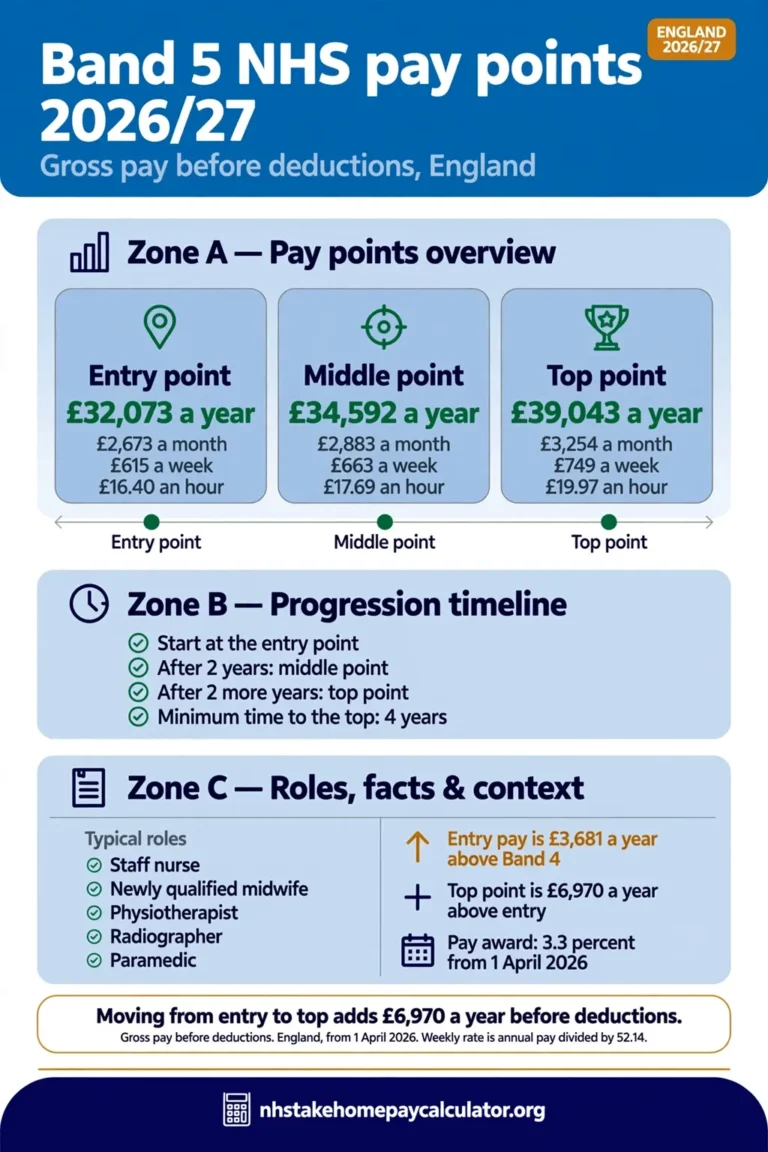
Band 6 is where experienced nurses, senior therapists and specialist practitioners sit. For 2026/27 the three pay points are £39,959, £42,170 and £48,117 before deductions.
Every Band 6 point falls inside the same 9.8% pension tier, which makes this one of the easiest bands to predict. Take-home rises in a steady line as you move up.
This guide shows what that becomes on your payslip. It covers Band 6 take home pay at each pay point, the 9.8% pension rate at entry, London weighting, part-time hours, night and weekend shifts, and student loan plans. Use the calculator above to try your own numbers.
In this guide
- What changed for Band 6 take home pay in 2026/27
- Who is on Band 6?
- Band 6 take home pay at a glance
- Band 6 pay scale for 2026/27
- How much is Band 6 take home pay a month?
- Where your Band 6 pay goes
- NHS Pension at Band 6
- Band 6 with London weighting
- How to work out Band 6 take home pay yourself
- A Band 6 band with no pension kinks
- Working part-time at Band 6
- Nights, weekends and bank holidays at Band 6
- Overtime and bank shifts
- Student loan deductions at Band 6
- Moving up: pay progression at Band 6
- Three Band 6 take home pay examples
- Band 6 compared with the bands either side
- Salary sacrifice and other changes to Band 6 take home pay
- Ways to increase your Band 6 take home pay
- Common mistakes when estimating Band 6 take home pay
- Checking your Band 6 payslip
- Frequently asked questions
- Sources
What changed for Band 6 take home pay in 2026/27
Basic pay rose by 3.3% on 1 April 2026, which lifts the Band 6 entry point by roughly £1,277 a year to £39,959. The NHS Pension tier ceilings also rose by 3.8%, so fewer people are pushed into a higher pension rate by the pay rise. The tax rules didn’t change: a £12,570 tax-free allowance, 20% basic rate and 8% employee National Insurance.
The net effect for Band 6 is a modest gain. Our 2026/27 pay rise guide covers the award in each nation, and the pay rise calculator shows what it means for your own salary.
Who is on Band 6?
Band 6 roles include senior and specialist nurses, ward sisters and charge nurses in many trusts, experienced midwives, senior physiotherapists, senior occupational therapists, advanced radiographers and some paramedics with extra responsibility.
Most people reach Band 6 from Band 5 after several years of experience, and often after extra training. Some trusts advertise development posts that start at Band 5 and are regraded to Band 6 when you finish a set of competencies.
The banding comes from the job, not from you. If your duties have grown, ask for a job evaluation. Our Agenda for Change guide explains how that works.
Band 6 take home pay at a glance
This table puts the most common situations side by side. Every row is a full-time, England-based example unless it says otherwise, and every row uses 2026/27 rules.
| Situation | Gross a year | Take-home a month |
|---|---|---|
| Entry point, no extras | £39,959 | £2,429.77 |
| Middle point | £42,170 | £2,547.99 |
| Top point | £48,117 | £2,865.96 |
| Entry point, Plan 2 student loan | £39,959 | £2,350.47 |
| Entry point, 30 hours a week | £31,967 | £2,034.45 |
| Entry point, Fringe zone | £41,957 | £2,536.60 |
| Entry point, Outer London | £45,953 | £2,750.25 |
| Entry point, Inner London | £47,951 | £2,857.07 |
Band 6 pay scale for 2026/27
Band 6 has three pay points in England. You start at the entry point, move to the middle point after 2 years, and reach the top point after 3 more years. The minimum time to the top is 5 years.
| Pay point | Per year | Per month | Per hour |
|---|---|---|---|
| Entry | £39,959 | £3,329.92 | £20.44 |
| Middle | £42,170 | £3,514.17 | £21.57 |
| Top | £48,117 | £4,009.75 | £24.61 |
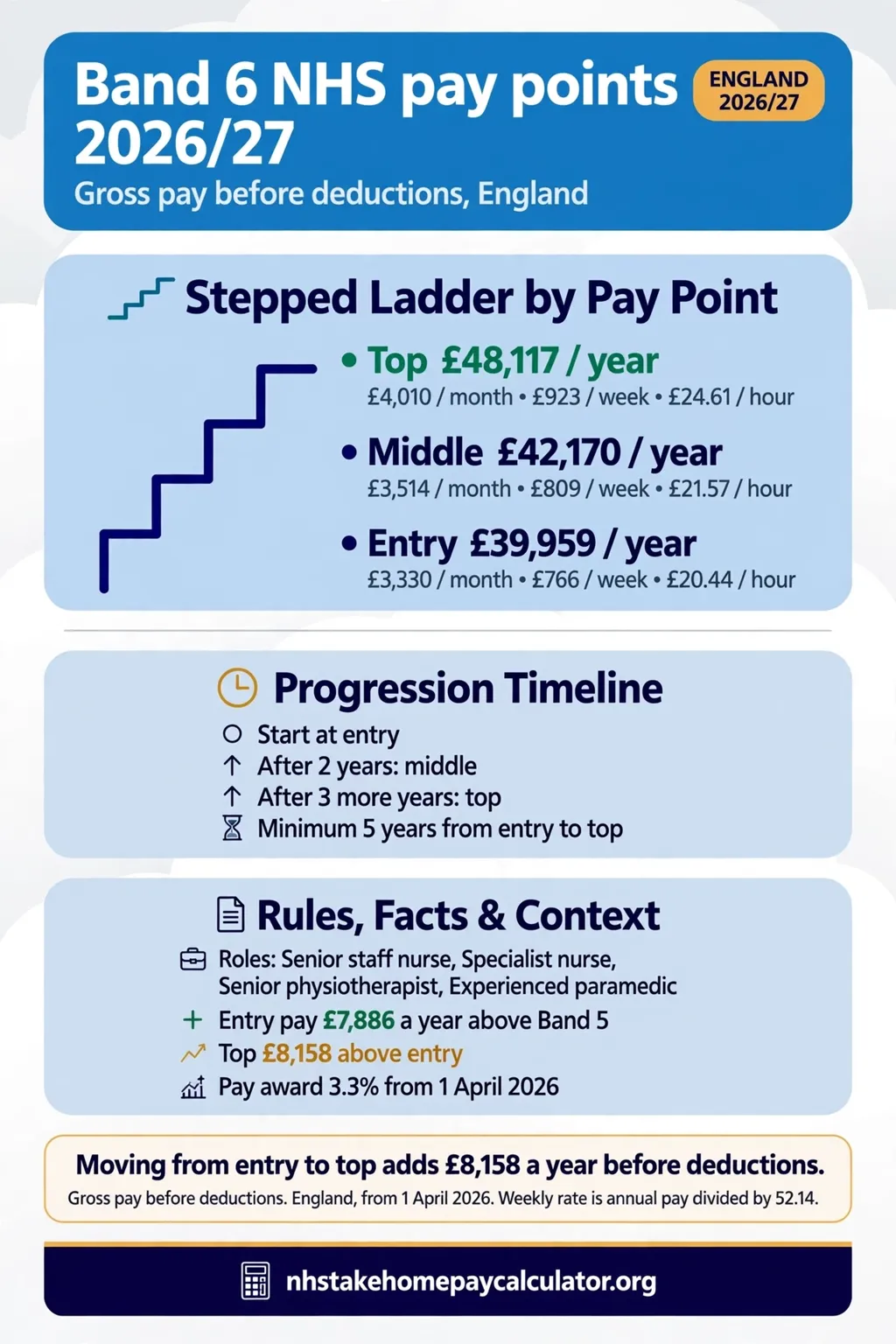
These are gross figures. Tax, National Insurance and pension come out before the money reaches your bank. The hourly rates are the official NHS Employers rates for England. If you work in Scotland, Wales or Northern Ireland, your scale is different. See our guide to NHS pay in the other UK nations.
How much is Band 6 take home pay a month?
Band 6 take home pay at the entry point is £2,429.77 a month, or £29,157 a year. At the top point it is £2,865.96 a month. The gap between the two is £436.18 a month.
| Pay point | Gross a month | Pension rate | Take-home a month | Take-home a year |
|---|---|---|---|---|
| Entry | £3,329.92 | 9.8% | £2,429.77 | £29,157 |
| Middle | £3,514.17 | 9.8% | £2,547.99 | £30,576 |
| Top | £4,009.75 | 9.8% | £2,865.96 | £34,391 |
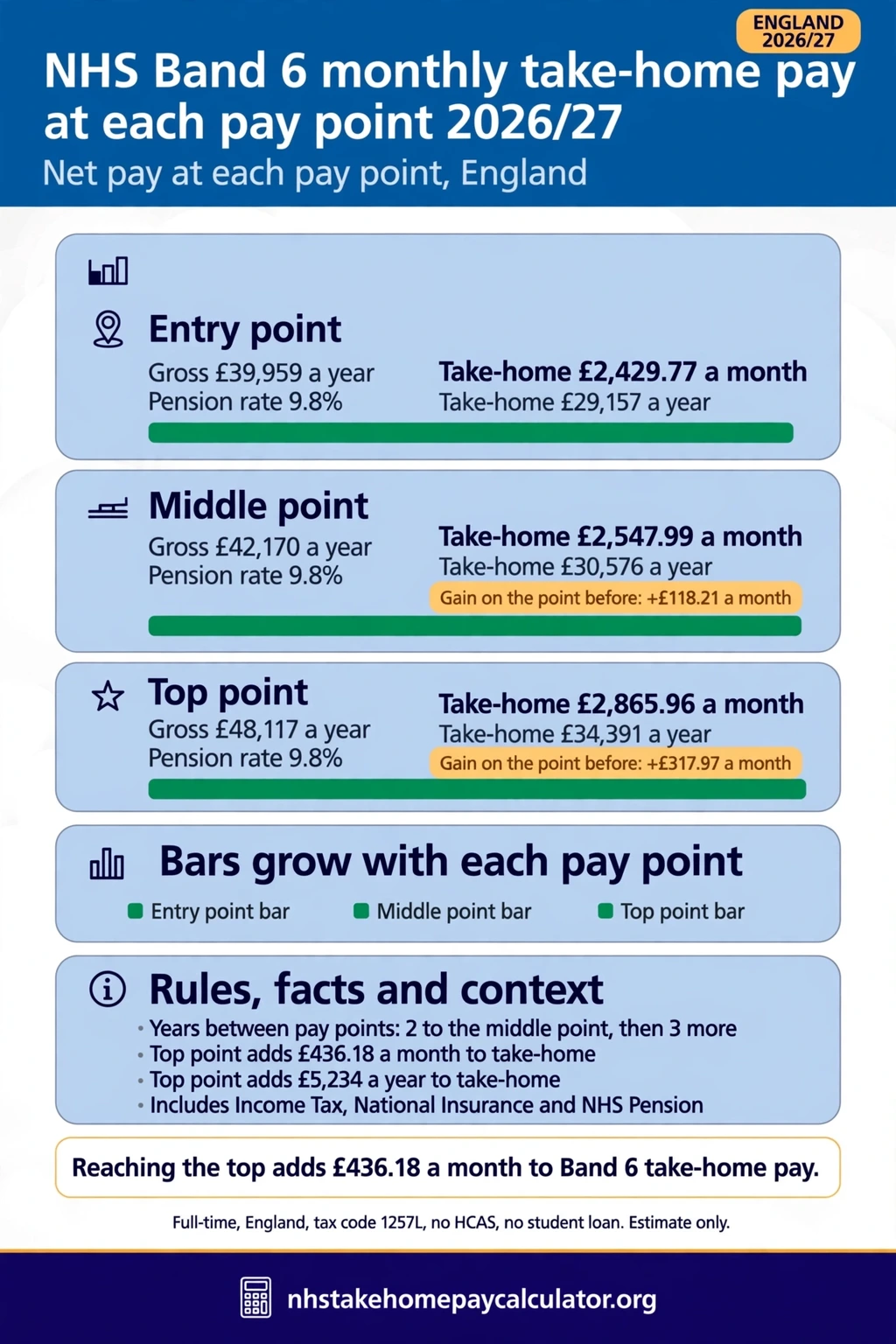
Because the pension rate is the same at every point, each step up delivers a clean, predictable slice of the extra pay.
Your weekly take-home works out at roughly £559.18 at entry, though most NHS staff are paid monthly.
Where your Band 6 pay goes
At the entry point, 73.0% of your gross pay reaches your bank. The rest goes on three things: NHS Pension, Income Tax and National Insurance.
| Line | Per month | Per year | Share of gross |
|---|---|---|---|
| Gross pay | £3,329.92 | £39,959 | 100% |
| NHS Pension | £326.33 | £3,916 | 9.8% |
| Income Tax | £391.22 | £4,695 | 11.7% |
| National Insurance | £182.59 | £2,191 | 5.5% |
| Take-home pay | £2,429.77 | £29,157 | 73.0% |
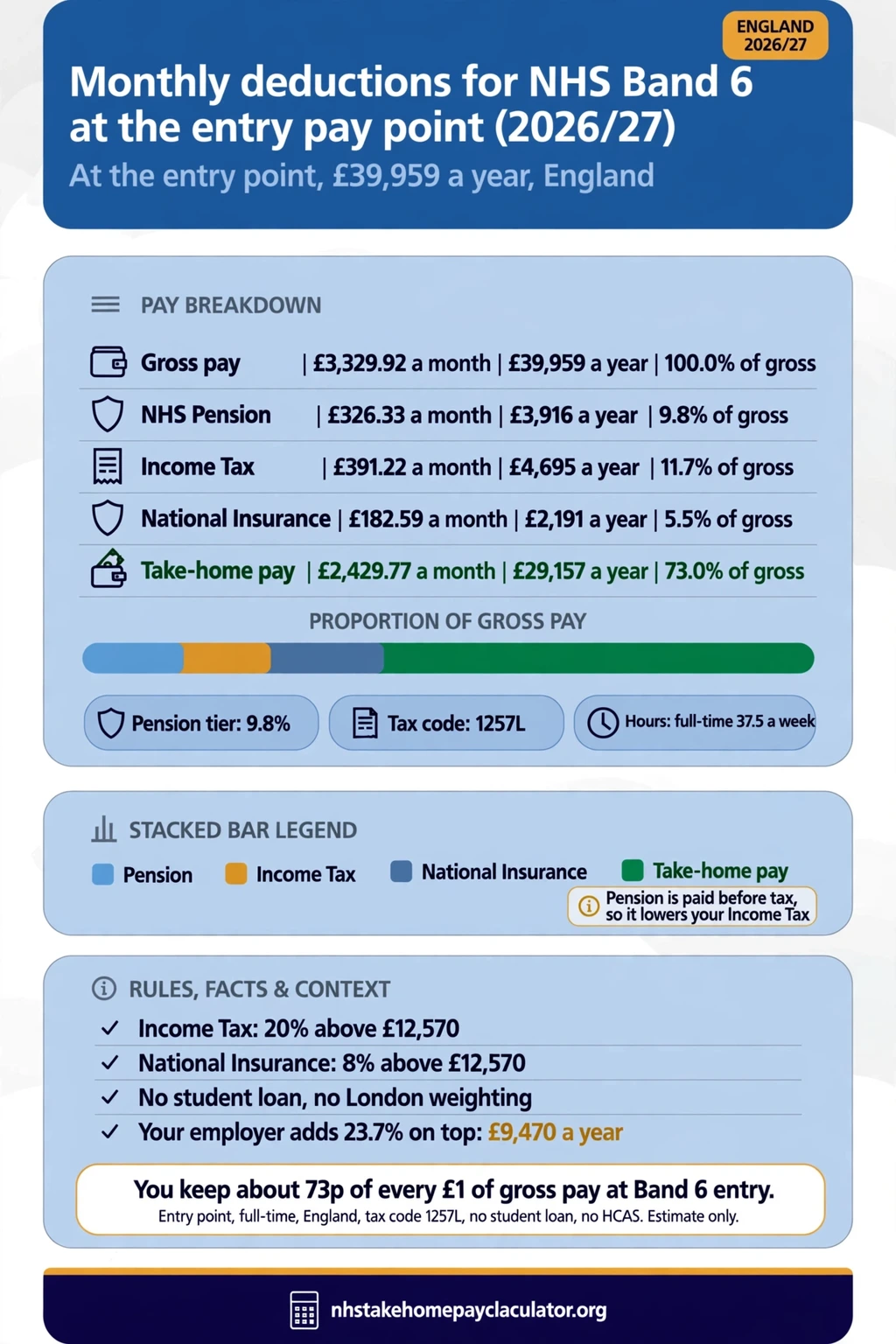
Income Tax is 20% on pay above the £12,570 personal allowance. National Insurance is 8% on pay between £12,570 and £50,270. Pension contributions come off before tax is worked out, so you pay less Income Tax than you would without the scheme.
NHS Pension at Band 6
Your pension rate depends on your pensionable pay, not your band. Pensionable pay between £35,156 and £52,778 is charged at 9.8%. All three Band 6 points fall in that range. With Inner London weighting, entry pay rises to £47,951 and the rate is 9.8%.
The cost is £326.33 a month at entry. Because the contribution comes out before tax, your take-home falls by less than that. Without the pension, entry take-home would be about £2,690.84 a month, so the real cost to your pocket is roughly £261.07.
In return, your employer pays 23.7% of your pensionable pay into the scheme. At Band 6 entry that is about £9,470 a year. You also build pension each year equal to one fifty-fourth of your pensionable pay, which is £739.98 at entry.
Want the full picture? Our NHS Pension calculator shows your tier, your yearly cost and what you build. The pension contribution rates guide explains all six tiers.
Band 6 with London weighting
If you work in or near London you also get the High Cost Area Supplement (HCAS). It is a percentage of basic pay, held between a minimum and maximum for each zone. HCAS is taxable and counts as pensionable pay.
| Zone | HCAS a year | Annual pay with HCAS | Take-home a month | Extra a month |
|---|---|---|---|---|
| No HCAS | £0 | £39,959 | £2,429.77 | £0.00 |
| Fringe (5%) | £1,998 | £41,957 | £2,536.60 | +£106.82 |
| Outer London (15%) | £5,994 | £45,953 | £2,750.25 | +£320.47 |
| Inner London (20%) | £7,992 | £47,951 | £2,857.07 | +£427.29 |
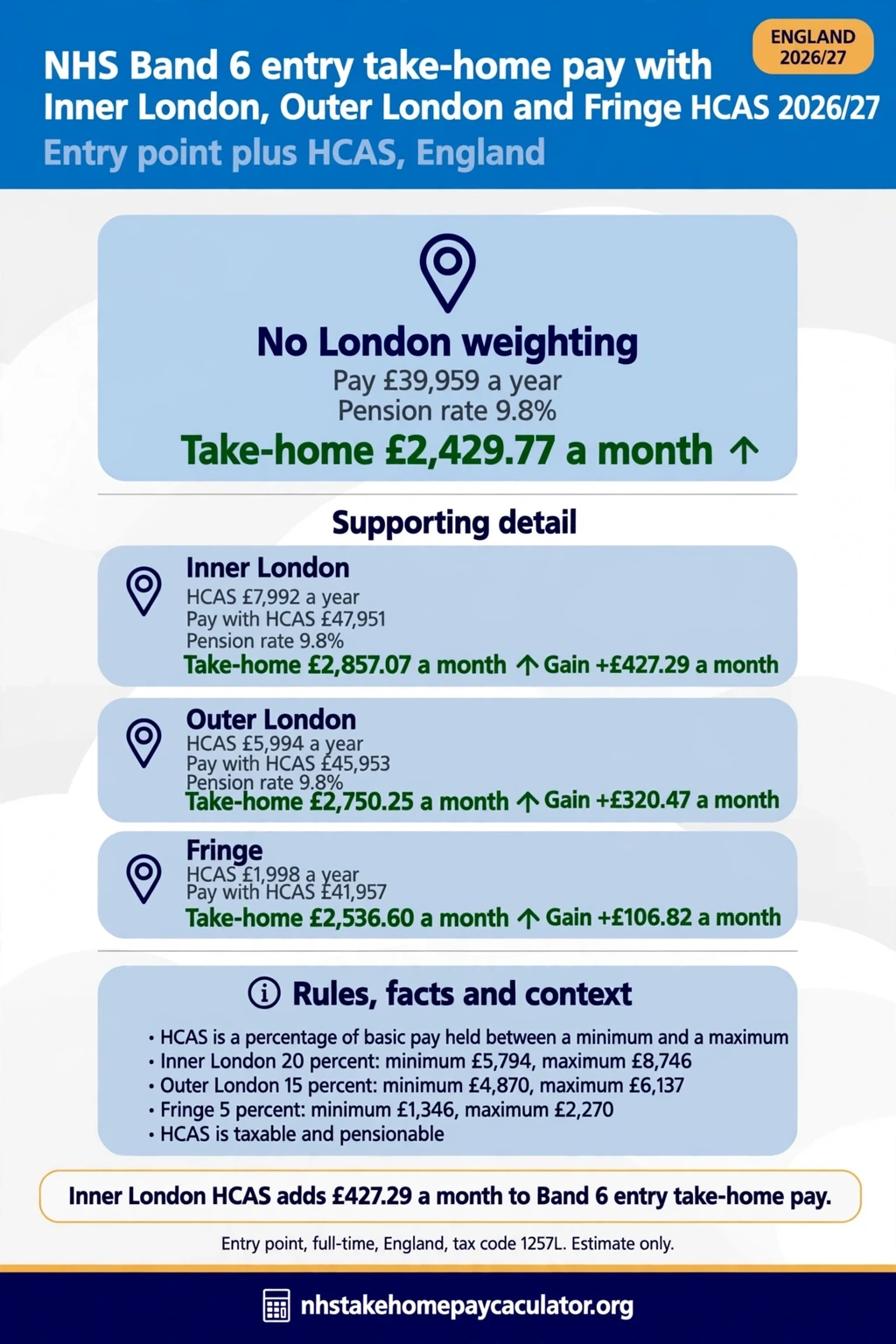
At Band 6 you should check the HCAS table for your zone, because the percentage and the minimum both matter at this pay level. The Inner London figure above uses the zone rules built into our calculator. Extra pay is taxed, so you keep less than the headline amount. Use our London weighting calculator for other bands and zones, or read the full HCAS rates guide.
How to work out Band 6 take home pay yourself
You don’t need a spreadsheet to estimate your Band 6 take home pay. Follow these five steps. The worked figures use the entry point of £39,959 and a standard tax code.
- Start with gross pay. Take your annual salary: £39,959.
- Take off pension. Find your tier. At £39,959 the rate is 9.8%, so pension is £3,916. That leaves £36,043 to be taxed.
- Work out Income Tax. Subtract the £12,570 allowance from £36,043 to get £23,473. At 20% the tax is £4,695.
- Work out National Insurance. Use your gross pay, not the reduced figure. £39,959 minus £12,570 is £27,389. At 8% that’s £2,191.
- Subtract and divide. £39,959 less £3,916, £4,695 and £2,191 leaves £29,157. Divide by 12 for £2,429.77 a month.
If you have a student loan, take 9% of pay above your threshold from the result. If you receive HCAS, add it to gross pay in step 1 and check whether it changes your pension tier. The calculator at the top of this page does all of this for you.
A Band 6 band with no pension kinks
Bands 5 and 4 have pension tier lines to cross. Band 6 doesn’t. At every point you pay 9.8%, so the share of each extra £1 you keep is stable: about 64p from entry to middle and 64p from middle to top.
In money terms, take-home rises by £118.21 a month from entry to middle and by £317.97 a month from middle to top. The total climb from entry to top is £436.18 a month.
That predictability helps with planning. If you’re budgeting for a mortgage at the top point, you can trust the top-point figure in the table above without a hidden tier change waiting for you.
Pay on a Band 6 salary is also more likely to include enhancements. Our unsocial hours guide explains how Band 6 gets +30% and +60%.
Working part-time at Band 6
Part-time pay is your full-time salary multiplied by your hours divided by 37.5. A 30-hour week is 80%, so the entry salary becomes £31,967 a year.
| Weekly hours | Pro-rata pay a year | Pension rate | Take-home a month |
|---|---|---|---|
| 37.5 | £39,959 | 9.8% | £2,429.77 |
| 30 | £31,967 | 8.3% | £2,034.45 |
| 22.5 | £23,975 | 6.5% | £1,627.93 |
Your pension tier uses your actual pay. At 30 hours, entry pay is £31,967, which sits in the 8.3% tier. Dropping hours cuts take-home by less than the share of hours you give up, because tax and pension both fall. Try your own pattern in the part-time pay calculator.
Nights, weekends and bank holidays at Band 6
Band 6 gets +30% for Saturdays and for weekday hours between 8pm and 6am, and +60% for Sundays and public holidays. At the entry rate of £20.44 an hour, that is £26.57 and £32.70.
A 12-hour Sunday shift at the entry rate pays £392.45 before tax, compared with £245.28 on a plain-rate day. On a 7pm to 7am weekday night shift, ten of the twelve hours attract the +30%. Hours between 7pm and 8pm, and between 6am and 7am, are paid at the plain rate.
Band 6 gets +30% on Saturdays and weekday nights and +60% on Sundays and public holidays, the same group as Bands 4 to 9. The plain hourly rate is higher, so each enhanced hour is worth more in pounds.
Our unsocial hours guide lists every band, and the unsocial hours calculator totals up your own rota.
Overtime and bank shifts
Overtime is paid at time and a half, with double time on general public holidays. At entry that is £30.66 and £40.88 an hour. Part-time staff get the plain rate for extra hours up to full-time hours, and overtime rates apply after that.
Bank shifts are different. Your trust sets the rate, so check its rate card. Extra pay is taxed at your top rate, so a basic-rate taxpayer keeps about 72p of each extra £1. If you have a student loan, it is nearer 63p. Read more in our guide to bank shift pay and overtime rules.
Student loan deductions at Band 6
Repayments are 9% of pay above your plan’s threshold, or 6% for a postgraduate loan. The figures below are for the entry point.
| Plan | Threshold | Repayment a month | Take-home a month |
|---|---|---|---|
| Plan 1 | £26,900 | £97.94 | £2,331.83 |
| Plan 2 | £29,385 | £79.30 | £2,350.47 |
| Plan 4 | £33,795 | £46.23 | £2,383.54 |
| Plan 5 | £25,000 | £112.19 | £2,317.58 |
| Postgraduate | £21,000 | £94.80 | £2,334.98 |
Every plan repays something at this pay point. You can check your plan on your student finance account. Our student loan deductions guide explains each plan, and the repayment calculator lets you test your own pay.
Moving up: pay progression at Band 6
You move to the next pay point on your pay-step date, normally the anniversary of starting in the band. It is not always your start date, so ask payroll to confirm yours in writing.
Progression depends on more than time served. Most trusts expect a review and evidence that you meet the skills and performance needed for the post. Our pay progression guide walks through what usually happens.
Over 5 years, gross pay at Band 6 rises by £8,158. After deductions, take-home rises by £5,234 a year. With three points, Band 6 has two steps. Check both dates on your pay-step letter.
Three Band 6 take home pay examples
Example 1: a specialist nurse at the middle point. She works 37.5 hours in Leeds with no student loan. Her Band 6 take home pay is £2,547.99 a month.
Example 2: an occupational therapist in Outer London. HCAS adds £5,994 a year, taking pay to £45,953. A Plan 2 loan takes £124.26 a month, leaving £2,625.99.
Example 3: a senior physiotherapist at the top point on 30 hours. Pro-rata pay is £38,494, pension is 9.8%, and take-home is £2,351.42 a month.
Compare each with the headline figure on your payslip. Small differences of a few pounds usually come from rounding or a different tax code. Larger gaps are worth a conversation with payroll.
Band 6 compared with the bands either side
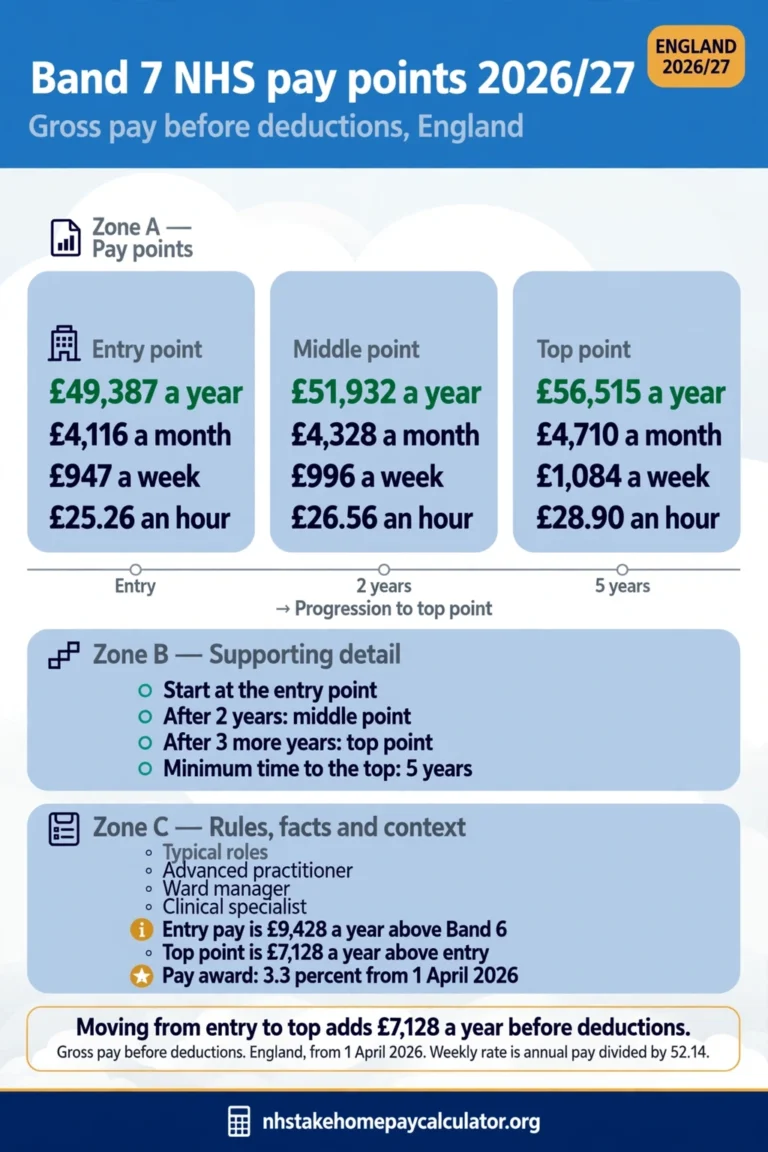
Band 5 top to Band 6 entry is a rise of £916 a year before deductions, so it’s a real step. From Band 6 top to Band 7 entry the rise is £1,270.
Read the Band 5 guide and the Band 7 guide for the neighbouring bands.
You can compare every band on the NHS pay bands page.
Salary sacrifice and other changes to Band 6 take home pay
Several things can move your Band 6 take home pay up or down: a cycle to work scheme, a car lease, extra shifts, a change of hours or a new tax code. A salary sacrifice of £600 a year lowers entry take-home by roughly £32.08 a month for a benefit worth £50 a month. The saving comes from tax and National Insurance.
Check what a scheme does to your pensionable pay before you sign. Try the salary sacrifice calculator, or read about how the schemes work.
Ways to increase your Band 6 take home pay
Band 6 take home pay is set mostly by your pay point, but a few things are in your control.
- Hit each pay-step date. Entry to middle adds £118.21 a month.
- Pick up enhanced hours. +30% and +60% apply to Band 6.
- Look at Band 7. Entry pay is £1,270 above Band 6 top.
- Check HCAS. Confirm your zone and rate are right on your payslip.
- Check your tax code after any change of hours or second job.
Be realistic about extra work. A basic-rate taxpayer keeps about 72p of each extra £1, and less with a student loan. Rest matters too, so don’t rely on extra shifts to fix a monthly gap.
Common mistakes when estimating Band 6 take home pay
People often get their Band 6 take home pay wrong in the same few ways.
- Using the gross figure from a job advert and forgetting pension, tax and National Insurance.
- Applying one pension rate to every pay point. Rates change when pay crosses a tier line.
- Forgetting that HCAS is taxed and counts towards your pension tier.
- Assuming a student loan is taken from net pay. It’s calculated on gross pay above the threshold.
- Using the wrong hours. A 30-hour week is 80% of full-time, not 75%.
- Expecting the same figure every month. Overtime, enhancements and tax code changes all move it around.
A calculator gives an estimate. Your payslip is the final word, so compare the two and ask payroll about any gap you can’t explain.
Checking your Band 6 payslip
Four checks catch most mistakes. First, make sure your band and pay point match your contract. Second, compare the hours paid with your roster. Third, confirm your pension rate is 9.8% at entry. Fourth, check your tax code, which is normally 1257L for one job.
If a line looks wrong, tell payroll in writing and keep a copy. Our guides on the NHS payslip and on overpayments and underpayments explain what to do next.
Frequently asked questions
How much is NHS Band 6 take home pay a month?
NHS Band 6 take home pay in 2026/27 is about £2,429.77 a month at the entry point and £2,865.96 at the top point. That is for a full-time employee in England on tax code 1257L, paying into the NHS Pension with no student loan. London weighting, extra shifts or a student loan change the figure.
What is the Band 6 pension rate in 2026/27?
NHS Band 6 staff pay 9.8% of pensionable pay into the NHS Pension at the entry point in 2026/27, because pensionable pay is £39,959. The rate is the same at every pay point in this band. Your employer pays a further 23.7%, and your contribution comes off before income tax.
How much is Band 6 with Inner London weighting?
At the entry point, Inner London weighting adds £7,992 a year to Band 6 pay. That lifts annual pay to £47,951 and take-home to about £2,857.07 a month. Outer London adds £5,994, giving £2,750.25 a month, and the Fringe adds £1,998, giving £2,536.60 a month.
How much is Band 6 take home pay on 30 hours?
On 30 hours a week, Band 6 pays £31,967 a year at the entry point and takes home about £2,034.45 a month in 2026/27. Part-time pay is your weekly hours divided by 37.5, multiplied by the full-time salary, and a lower pensionable pay can also put you in a lower pension tier.
Does Band 6 get paid more for nights and weekends?
Yes. Band 6 gets +30% on Saturdays and on weekday hours between 8pm and 6am, and +60% on Sundays and public holidays. The percentage is added to your plain hourly rate, and the extra pay is taxable. Our unsocial hours guide has worked examples for each band.
Is the pension rate the same at every Band 6 point?
Yes. All three Band 6 points are between £35,156 and £52,778 of pensionable pay in 2026/27, so you pay 9.8% at every point. The rate doesn’t rise as you progress, so take-home grows steadily with each step, apart from tax and National Insurance on the extra pay.
How long does it take to reach the top of Band 6?
Band 6 has three pay points, and the usual gap is two to three years each, depending on your employer’s rules, so check your contract. In 2026/27 the points are £39,959, £42,170 and £48,117 a year.
Sources
- NHS Employers: pay and pensions
- NHS Business Services Authority: NHS Pension Scheme
- GOV.UK: Income Tax rates and allowances
- GOV.UK: National Insurance rates and categories
Our own sources and methodology page explains how every figure here is calculated.
Work out your own take-home pay
Enter your band, pay point and hours in the free NHS take home pay calculator for 2026/27.